Inside a refinery: distillation, cracking and the product slate
What happens to a barrel of crude between the tank farm and the truck rack: distillation, cracking, coking, hydrotreating, reforming, alkylation and blending.
 By Esteban Villarreal9 min read
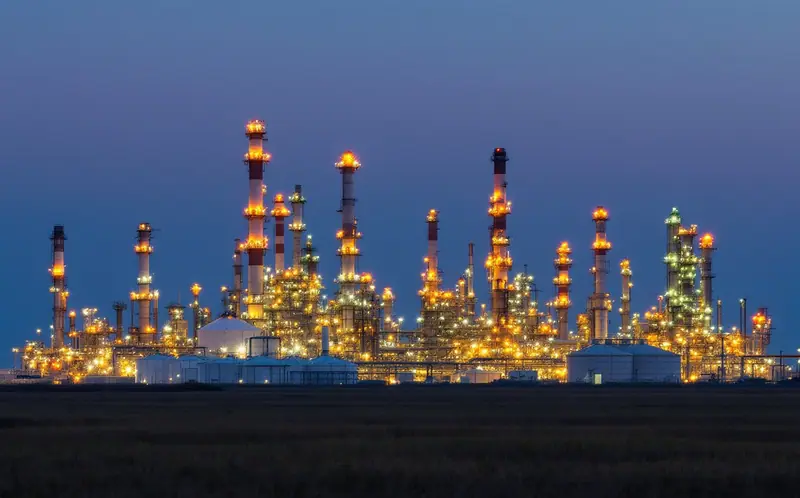
Drive the highway along the ship channel near Corpus Christi or Houston at night and the refineries look like small cities that never switch off. In a sense that is what they are. The US Energy Information Administration notes that a refinery runs 24 hours a day, 365 days a year, and can cover as much ground as several hundred football fields. From the road it is a blur of towers, stacks, tanks and pipe racks. Up close, it is a sequence of steps, and once you know the sequence you can read the skyline.
This is a walk through that sequence: where the crude comes in, how it is split, how the heavy parts are turned into lighter ones, how sulfur is pulled out, and how the final products are blended and shipped. It ends with why no two refineries are quite alike.
Three jobs: separate, convert, treat
EIA's page on the refining process breaks the work into three groups. Separation splits crude into fractions by boiling point. Conversion breaks big, heavy molecules into smaller, more valuable ones, or rearranges small ones into better gasoline parts. Treatment and blending take the streams that come off all those units, remove what is not wanted, sulfur above all, and mix them into finished fuels that meet a specification.
Almost every unit in the plant belongs to one of those three groups. Keep them in mind and the process diagram stops looking like a plate of spaghetti.
Arrival and the tank farm
Crude reaches a refinery by pipeline, tanker, barge or rail, and it goes into storage first. The tank farm is the refinery's buffer. It holds different crudes so they can be blended into a feed the plant is set up to run, and it holds finished products until a pipeline, ship, train or truck takes them away. Many of the incoming lines are pigged on a schedule to keep wax and water down, and the pigging explainer covers what that involves.
Before crude goes anywhere near the main column it is warmed and washed. Crude carries water with dissolved salts, along with sand and silt. The salts can turn into corrosive acids at high temperature and the solids foul heat exchangers, so a desalter mixes the warm crude with fresh water and separates the water back out, taking most of the salt with it. It is a modest-looking vessel and one of the first stops in the plant.
The crude unit: splitting by boiling range
After desalting, the crude is heated further, first by swapping heat with hot product streams and then in a fired furnace, to roughly 400 °C (about 750 °F). It enters the bottom of a tall atmospheric distillation column as a mix of hot liquid and vapor. The column is hottest at the bottom and coolest at the top. Light molecules rise as vapor and condense on trays high up. Middle-weight molecules condense partway. The heaviest material never vaporizes and collects at the bottom.
Side draws at different heights pull off each fraction. The ranges below are approximate and overlap, because every refinery sets its own cut points for the crude it runs and the products it wants.
| Fraction | Approximate boiling range | Where it goes |
|---|---|---|
| Light gases (propane, butane and lighter) | Below about 30 °C (86 °F) | Refinery fuel gas, liquefied petroleum gas, alkylation feed |
| Light naphtha | About 30 to 145 °C (86 to 293 °F) | Gasoline blending, isomerization, petrochemical feed |
| Heavy naphtha | About 140 to 205 °C (284 to 401 °F) | Catalytic reformer, then gasoline |
| Kerosene | About 150 to 275 °C (302 to 527 °F) | Jet fuel, kerosene |
| Diesel and gas oil (middle distillate) | About 200 to 350 °C (392 to 662 °F) | Diesel, heating oil |
| Atmospheric residue | Above about 350 °C (662 °F) | Vacuum distillation unit |
Every refinery has an atmospheric unit. The more complex ones send the residue from the bottom of it to a vacuum unit, which is the next stop.
The vacuum unit: getting more out of the bottom
The residue from the atmospheric column still contains a lot of useful material, but heating it hot enough to boil at normal pressure would start to crack it into coke and gas in the wrong place. Lowering the pressure lowers the boiling points. So the residue goes to a vacuum column, usually a fat, squat tower next to the crude unit, where heavy gas oils boil off at temperatures the material can stand.
What comes out is vacuum gas oil, the main feed for the cracking units, and vacuum residue, the heaviest, thickest stream in the plant. Vacuum residue can become asphalt or heavy fuel oil, or it can go to a coker.
Conversion: breaking big molecules
Straight distillation gives you whatever the crude happens to contain. For most crudes that is not enough gasoline and diesel and too much heavy material. Conversion units fix the mismatch. EIA describes cracking as the most widely used conversion method: heat, pressure, catalysts and sometimes hydrogen break large hydrocarbon molecules into smaller ones.
- Fluid catalytic cracker (FCC). Gas oil meets a hot, powdered catalyst that flows almost like a liquid. The heavy molecules crack into gasoline-range material and light gases rich in olefins (propylene and butylenes), which are useful later in the alkylation unit. An FCC is easy to spot: a tall reactor and regenerator side by side, joined by large pipes carrying the catalyst back and forth.
- Hydrocracker. Vacuum gas oil is cracked over a catalyst in the presence of hydrogen at high pressure. Its main products are jet fuel and diesel, with some low-sulfur naphtha and liquefied gases. The feed is usually hydrotreated first, because sulfur and nitrogen would poison the cracking catalyst. Look for heavy, thick-walled reactors and a hydrogen supply.
- Coker. Vacuum residue is heated in a furnace to cracking temperature and sent to large drums, where it breaks down into lighter liquids and gas and leaves solid petroleum coke behind. The coke drums work in pairs, one filling while the other is cooled and its coke cut out with high-pressure water jets, and the coke piles beside them are one of the plainest signs that a refinery runs heavy crude.
Treating: taking the sulfur out
Most streams that leave the crude unit or the cracking units carry sulfur, and fuel specifications allow very little of it. Hydrotreaters pass each stream over a catalyst with hydrogen, which converts the sulfur compounds into hydrogen sulfide. The hydrogen sulfide is scrubbed out of the gas with an amine solution and sent to a sulfur recovery unit, which typically uses the Claus process, patented in 1883, to turn it into elemental sulfur. That sulfur is sold as a product, much of it to the chemical industry.
Hydrogen sulfide is one of the main hazards inside a refinery fence, for the same reasons it is in the field, and our article on hydrogen sulfide on site explains why crews wear personal monitors and train for it.
Upgrading gasoline: reforming, alkylation and isomerization
A gasoline pool needs octane, and straight-run naphtha does not have much. Three units exist mainly to raise it.
- Catalytic reformer. Heavy naphtha passes over a catalyst at high temperature and moderate pressure, and its molecules are reshaped into aromatics and other compounds with a much higher octane number. The product is called reformate. The reformer also gives off hydrogen, which is handy, because the hydrotreaters and hydrocracker need it.
- Alkylation. EIA describes it as cracking run in reverse. Isobutane is combined with the light olefins from the FCC to make alkylate, a clean, high-octane blending stock. The catalyst is a strong acid, either sulfuric acid or hydrofluoric acid, so these units have their own safety rules and equipment.
- Isomerization. Straight-chain light naphtha molecules such as normal pentane are rearranged into branched ones with a better octane number. A butane isomerization unit can also make isobutane for the alkylation unit.
Blending and shipping
None of the units above makes finished gasoline on its own. Gasoline is a recipe: reformate, alkylate, FCC gasoline, isomerate, butane and light naphtha, mixed in proportions that hit the required octane, vapor pressure and other limits for the season and the market. Fuel ethanol is often mixed in later at a blending facility or terminal. Diesel and jet fuel are blended the same way from the hydrotreated middle distillate streams. The finished products go to tanks, are tested, and then leave by pipeline, ship, rail or truck.
A worked example: what one barrel turns into
EIA's page on refinery inputs and outputs gives a useful snapshot. A US barrel is 42 gallons. In 2023, US refineries produced on average about 44.6 gallons of products from each 42-gallon barrel of crude, a processing gain of about 6.3 percent. The gain is real but it is a gain in volume, not in mass: most products are less dense than the crude they came from, so the same weight takes up more room.
Of those roughly 44.6 gallons, EIA puts finished motor gasoline at about 19.6 gallons, distillate fuel oil (mostly diesel) at about 12.5 gallons and kerosene-type jet fuel at about 4.4 gallons. Petroleum coke, still gas used as refinery fuel, hydrocarbon gas liquids, asphalt, residual fuel oil, lubricants and petrochemical feeds make up the rest in smaller amounts.
Now follow that barrel through the steps above, in round illustrative terms. At the crude unit a share goes overhead as gas and naphtha, a share comes off as kerosene and diesel, and a large share drops to the bottom as residue. The vacuum unit splits that residue into gas oil and vacuum residue. The FCC and hydrocracker turn most of the gas oil into gasoline and diesel range material, the coker turns the vacuum residue into lighter liquids plus coke, and the reformer and alkylation unit lift the octane of the gasoline parts. Every one of those streams passes through a hydrotreater on its way. That is how a plant ends up with nearly half the barrel as gasoline, even though straight distillation of the same crude would give far less.
Why no two refineries are alike
Refineries are built around the crude they expect to run. EIA notes that crude is graded by density, measured as API gravity, and by sulfur content. Lighter crudes, with higher API gravity, already contain a lot of light material and can yield gasoline, diesel and jet fuel with fairly simple processing. Heavier, denser crudes give more low-value heavy material from distillation alone and need more costly conversion. High sulfur makes both processing and product quality harder. A common market dividing line is about 0.5 percent sulfur, below which crude is called sweet and above which it is called sour.
That gives two broad kinds of plant. A simple refinery is built around the atmospheric crude unit with a short list of treating and upgrading units, and it suits light sweet crude. A complex refinery adds vacuum distillation, an FCC, a hydrocracker, a coker and large sulfur recovery units, and it can take heavy sour crude, including diluted bitumen from operations like those in the SAGD explainer, and still turn most of it into light products. All that extra processing costs more, which is why a complex plant is built to make use of the heavy crudes a simple plant cannot.
So when you look at a refinery skyline, the clue is at the heavy end. Coke drums and big sulfur units mean a plant built for heavy sour crude. A skyline that stops at the crude unit and a few treating units means a plant that needs light sweet feed and has to find it.

Esteban Villarreal
Esteban is from Corpus Christi, Texas, and writes about pipelines, terminals and refining along the Gulf Coast and beyond. He likes a good process diagram and a clear answer to where the barrel goes next.