Hall E · Health, Safety & Environment
Hydrogen sulfide on site: what H2S awareness training covers
Why H2S is treated so seriously, where it turns up, why your nose cannot be trusted and what a course such as H2S Alive teaches before you reach a sour site.
 By Morag Tennant10 min read
If you work around oil and gas for any length of time, somebody will hand you a ticket before they hand you a wrench. On sour sites the first ticket is usually hydrogen sulfide training. People sometimes treat it as a box to tick on the way to the real job, and I understand why: a day in a classroom feels a long way from a wellsite. But H2S is one of the few hazards in the industry that can take a person down in a breath or two, without warning, and the course is built around that fact.
This piece explains what the gas is, where it turns up, and what a typical awareness course covers. It is general education. It does not replace training, your employer's procedures or the instructions of the people running your site, and it contains no rescue or first aid instructions, on purpose.
What hydrogen sulfide is
Hydrogen sulfide is a colorless gas with the formula H2S. OSHA's fact sheet describes it as flammable and extremely hazardous, with the familiar rotten egg smell. It occurs naturally in crude oil and natural gas, and it is also made when bacteria break down organic matter, which is why sewers, manure pits and wastewater plants have the same problem. Old names for it include sewer gas, stink damp and swamp gas.
In the oil patch, gas or crude that carries H2S is called sour. Sweet gas has little or none. The Canadian Centre for Occupational Health and Safety (CCOHS) lists sour gas as one of the common names for H2S itself, which tells you how closely the two ideas are tied together on a Western Canadian lease.
Three properties make it a site hazard rather than a nuisance.
- It is toxic. OSHA describes it as both an irritant and a chemical asphyxiant that affects how the body uses oxygen and the central nervous system.
- It is heavier than air. It can travel along the ground and collect in low spots: pits, cellars, sumps, ditches, the bottom of tanks and enclosed buildings with poor ventilation.
- It burns. OSHA gives its explosive range in air as 4.3 to 45 percent, and when it burns it produces sulfur dioxide, another toxic gas.
Where it turns up on an oil and gas site
Anywhere sour fluids are produced, stored, processed or vented is a candidate. The obvious places are sour wells during drilling, completions, testing and workovers. Less obvious places catch people out.
- Tank tops, thief hatches and gauge hatches, where gas collects above the liquid and comes out when the hatch is opened.
- Vessels, separators and filter housings opened for maintenance.
- Vacuum trucks and the tanks they empty.
- Pits, cellars, sumps and low ground downwind of a release.
- Gas plants, especially the inlet and acid gas sections.
- Sewers and drains on refinery and plant sites.
The gas also lingers. Sludge and scale inside a vessel can keep giving off H2S after the vessel has been drained, and water that has been in contact with sour production can release it later. That is one reason why work on equipment that once held sour fluids goes through a permit, isolation and air testing before anyone opens it.
Why your nose is not a gas detector
Most people can smell H2S at very low levels. OSHA's own table puts the odor threshold somewhere between 0.01 and 1.5 parts per million, depending on the person. That sounds reassuring until you read the next lines. With continuous exposure, or at high concentrations, people lose the ability to smell it even though it is still there. This is called olfactory fatigue, or olfactory paralysis. OSHA notes that at high concentrations the sense of smell can go instantly, and its fact sheet tells workers, in capital letters, not to rely on their nose.
The smell also changes with concentration. OSHA describes the odor as more offensive at 3 to 5 ppm and as sweet or sickeningly sweet above 30 ppm. So the moment the rotten egg smell fades is not necessarily the moment the air got better. It can be the moment it got much worse.
What the numbers mean
You will see a lot of ppm figures in H2S training. These are the ones OSHA publishes for the United States.
| Limit | Value | What it is |
|---|---|---|
| OSHA general industry ceiling | 20 ppm | Not to be exceeded, with one narrow exception |
| OSHA general industry peak | 50 ppm | Allowed once, for up to 10 minutes, only if there is no other measurable exposure that shift |
| OSHA construction limit | 10 ppm | 8-hour limit |
| NIOSH recommended limit | 10 ppm | 10-minute ceiling (a recommendation, not enforceable) |
| NIOSH IDLH | 100 ppm | Immediately dangerous to life and health |
CCOHS quotes the ACGIH threshold limit values, which are lower: 1 ppm as an 8-hour average and 5 ppm as a short-term ceiling. In Canada, each province and territory sets its own workplace exposure limits, and your employer's procedures will tell you which apply and where your personal monitor alarms are set. Do not assume one country's number holds in another.
OSHA also publishes a table of short-term effects by concentration. Read the whole thing on the OSHA hydrogen sulfide hazards page, but the outline is this: irritation of the eyes and airways at tens of ppm, loss of smell within minutes at around 100 ppm, collapse within minutes at 500 to 700 ppm, and at 700 to 1,000 ppm what the industry calls knockdown, rapid unconsciousness within one or two breaths. OSHA points out that the fall itself often injures the worker. Above that range the table simply says nearly instant death.
The gap between "you can smell it" and "it can kill you" is a few hundred ppm, and your nose may switch off in the middle of that gap. Everything in an H2S course follows from that.
What an H2S awareness course covers
In Canada the best known course is H2S Alive, run through Energy Safety Canada and delivered by authorized training providers. Energy Safety Canada describes it as a one-day classroom course for anyone who may work where H2S might be present, in any industry. It ends with an exam with a 70 percent pass mark and a certificate valid for three years. In other countries, employers and training bodies run their own H2S awareness and breathing apparatus courses with different names and lengths, and many operators set their own rules about which ones they accept.
The topic list for H2S Alive gives a fair picture of what any good course covers.
Properties and locations
The chemistry, in plain terms: the gas is toxic, heavier than air, flammable and corrosive, and it hides in the places listed above. Expect to spend time on the specific sources in oil and gas, from sour wells to vacuum trucks.
Health hazards
How exposure affects people at different concentrations, why smell is unreliable, and why repeated exposure is a concern. This is about recognizing the danger, not treating it.
Hazard assessment and control
How a site identifies where H2S might be, and the order in which controls are applied. OSHA's guidance follows the standard hierarchy: remove the source where you can, then engineering controls such as ventilation and closed systems, then work practices and permits, and finally personal protective equipment when the first three are not enough.
Respiratory protection
This is the hands-on part. Energy Safety Canada says H2S Alive participants must show they can put on a mask and breathe under supplied air, and take part in donning and doffing a self-contained breathing apparatus (SCBA). OSHA's fact sheet says entry into atmospheres at or above 100 ppm can only be made with a full facepiece, pressure-demand SCBA or an equivalent supplied-air system. That is why breathing air trailers and SCBA stations are a normal sight on sour drilling and completion sites.
Detection
Personal monitors, fixed detectors, area monitors and detector tubes: what each does, how to check that a monitor works before you rely on it, and what the alarms mean on your site.
Initial response
What the site expects you to do in the first minutes after an alarm: get out, get upwind, raise the alarm and account for people. H2S Alive includes practical exercises in rescue drag techniques with breathing apparatus on. I will not describe those here. They are taught by trainers with equipment and supervision for a reason.
A morning on a sour site, as a walk-through
To make the training concrete, here is an illustrative start to a shift on a sour wellsite. It is a composite of common practice, not a procedure. Every operator writes its own.
- Sign-in and orientation. At the gate or the site trailer you sign in and someone checks that your H2S ticket is current. A new visitor gets a site orientation: where the hazards are, where the muster points are, what the alarms sound like and who is in charge.
- Monitor check. You pick up or switch on a personal H2S monitor and test it the way the site requires, often with a bump test against a known gas. A monitor that has not been checked is a guess.
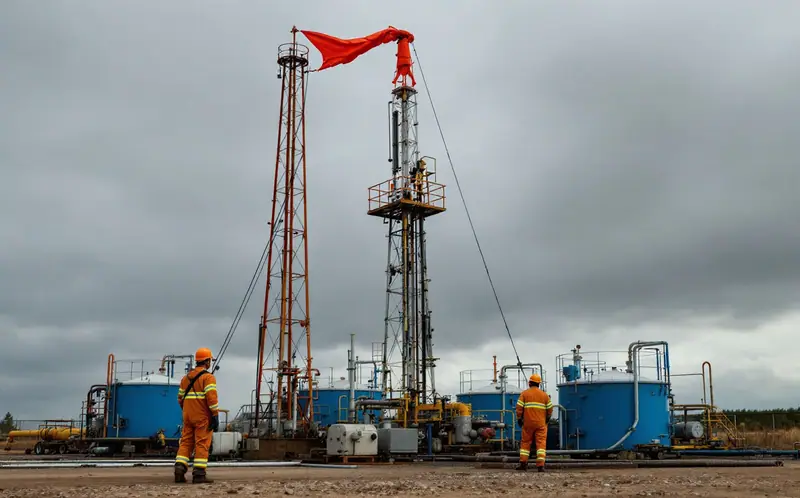
- Wind check. You look for the wind socks. Sour sites put them up high so anyone can see which way the wind is blowing from anywhere on the lease. Wind direction decides which muster point you head for.
- Muster points. Most sites have at least two, placed so that one is upwind whatever the weather. You note both before you start work.
- Breathing apparatus. You note where the SCBA and breathing air stations are, and who on the crew is trained and assigned to use them.
- The buddy system. On many sour sites, jobs near potential sources are done in pairs, with one person watching the other. Gauging a tank or opening a hatch alone is a common way for things to go wrong.
- The tailgate meeting. The crew goes over the day's tasks, the permits that cover them, where H2S might appear and what happens if a monitor goes off.
None of these steps is dramatic. That is the point. The course gives you the reasons, and the site gives you the routine.
The rescue rule
Every H2S course I have heard about repeats one rule, and OSHA prints it in its fact sheet: never attempt a rescue in an area that may contain hydrogen sulfide without appropriate respiratory protection and without being trained to perform that rescue. CCOHS adds that a casualty can be a hazard to rescuers, because the gas can come off their clothing, skin and breath.
The instinct to run in after a fallen workmate is strong and human. In H2S incidents it has also turned one casualty into two or three. The trained response is to raise the alarm, follow the site's emergency plan and let people wearing breathing apparatus go in. If someone needs medical help, call the local emergency number (911 in North America, 999 in the UK, 112 in the EU) and follow the site's emergency response plan. This article gives no medical advice and you should take none from it.
Questions people ask
Do I need an H2S ticket if I am only visiting?
Usually, if the site is sour or might be. Many operators require a current H2S certificate before anyone goes past the gate, visitors included. Ask the site contact before you travel, not when you arrive.
Is H2S Alive accepted outside Canada?
Acceptance is up to the employer and the site. Some operators abroad accept it, others want their own local course. Check with the company you will work for.
Can a gas detector replace training?
No. A monitor tells you there is a problem. Training tells you what to do in the next thirty seconds, and the site's procedures tell you where to go.
Where this fits
H2S is the gas that shapes how sour production is designed, from the amine units in a gas plant to the steel in a flowline. If you want the process side, our piece on the natural gas value chain covers how plants remove it. For more on site safety, the health, safety and environment hall collects related pieces, and the careers and training hall covers the other tickets you are likely to need. The last practical point is the simplest one: before you travel to any site, ask whether it is sour and whether your certificate is in date.

Morag Tennant
Morag lives in Aberdeen. She writes about health, safety and environmental practice on rigs, plants and pipelines: gas hazards, protective equipment, spill response, methane and the long work of decommissioning.