Hall E · Health, Safety & EnvironmentHall C · Natural Gas & LNG
Finding methane leaks: how LDAR surveys and gas cameras work
Where methane escapes on oil and gas sites, how crews find it with gas cameras, sniffers and aircraft, and what US and Canadian rules ask operators to record.
 By Morag Tennant10 min read
Methane is the main component of natural gas, and natural gas is the product. Every cubic meter that escapes from a valve stem or a tank hatch is gas that nobody gets to sell, and it is also a greenhouse gas with a much stronger short-term warming effect than carbon dioxide. Those two facts are why leak detection and repair, usually shortened to LDAR, has gone from a niche job to a routine part of running a well pad, a compressor station or a gas plant.
This piece explains where leaks come from, what an LDAR survey actually involves, the tools people use, and what the main North American rules require in general terms. Rules change, and dates in this field have moved more than once, so treat the regulatory sections as background and check the current text before relying on any detail.
Where the methane comes from
It helps to separate two kinds of emissions. Some come from equipment that is leaking when it should not be. Others come from equipment that releases gas as part of how it is designed to work. LDAR programs mostly chase the first kind, but a good survey team notices both.
Leaking components
The US Environmental Protection Agency lists the kinds of components that can leak at oil and gas sites, and the list reads like a walk around any pad: valves (including separator dump valves), connectors, flanges, pressure relief devices, open-ended lines, covers and closed vent systems, thief hatches and other openings on storage tanks, compressors, instruments, meters and yard piping.
Most of these leak for ordinary mechanical reasons. A valve stem packing wears. A threaded connector loosens after a few hundred cycles of heating and cooling. A gasket hardens. A tank hatch does not seat properly after someone gauges the tank. Many are small, but a site may have hundreds or thousands of components, and small leaks add up.
Equipment that vents by design
Some equipment releases gas as part of normal operation.
- Pneumatic controllers and pumps. On many older sites, valves and small pumps are driven by pressurized natural gas, because it is available and there is no power on site. Each time the device operates, or in some designs continuously, it vents a small amount of gas.
- Storage tanks. Liquids coming from a separator still carry dissolved gas, which flashes off in the tank. If the tank is not connected to a vapor recovery unit or a control device, the gas goes to the atmosphere.
- Compressors. Reciprocating compressors leak a little past the rod packing, and some centrifugal compressors release gas from their seals.
- Liquids unloading. Older gas wells can load up with water, and some unloading methods vent gas.
The EPA's 2024 rule for the sector sets separate standards for these sources, including a zero methane emission rate for new gas-driven process controllers and pumps (with exceptions for some sites without power) and limits on leakage from compressor seals and rod packing. Canada's 2018 federal regulations set a venting limit for pneumatic controllers of 0.17 cubic meters of natural gas per hour.
How a leak survey works
An LDAR program is a cycle: survey the site, tag what you find, repair it, check the repair, write it all down, and come back on schedule. The survey is the part people picture.
Audible, visual and olfactory checks
The simplest survey is a walk-around. The EPA calls it an AVO survey: inspectors listen for hissing, look for frost, staining, bubbling or dead vegetation, and smell for gas or condensate. Under the EPA rule, anything found this way counts as a leak. AVO checks are frequent and cheap, and they catch the large, obvious problems between instrument surveys.
Optical gas imaging
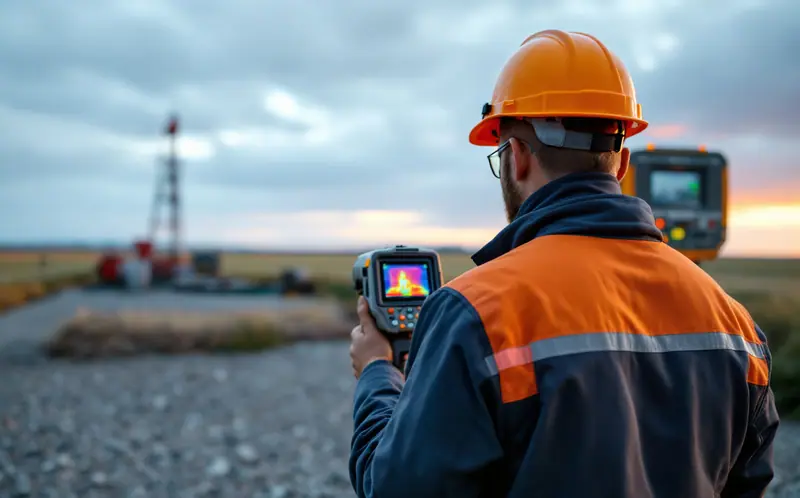
The tool most people associate with LDAR is the optical gas imaging camera, or OGI camera. It looks a little like a bulky video camera. EPA's technical material on its OGI protocol explains the principle: the molecules in a gas plume absorb or emit infrared light, and the camera filters incoming infrared to a narrow band where hydrocarbons such as methane have a strong absorption peak. On the screen, a leak shows up as a moving dark or light plume, something like heat shimmer or smoke, against the background.
OGI is fast. An experienced operator can scan a wellhead, separator and tank battery in minutes and see which fitting a plume is coming from. It also has limits. EPA notes that detection depends on the temperature difference between the gas and its background, the camera, the distance, how busy the background is, and the wind. Operator skill matters too, which is why EPA's protocol, Appendix K, covers operator training and auditing as well as the camera itself.
Method 21 and handheld sniffers
The older approach is EPA Method 21: a portable analyzer with a probe that the inspector moves around each component. It gives a concentration reading at the probe tip. Under the EPA rule, a reading of 500 parts per million or more counts as a leak. Method 21 is slower than a camera because it is one component at a time, but it gives a number, and it is still an accepted option for some site types.
Handheld gas detectors and soap solution also have their place. Once a camera has found a plume, a quick soap test on the suspect fitting often shows exactly where the gas is coming out.
Aircraft, drones, satellites and fixed sensors
Above the ground-level tools there is a growing set of remote methods: sensors on aircraft and drones, satellites that can spot large plumes, and continuous monitors fixed at a site. They cover more ground and are good at finding the big releases, sometimes called super-emitters. They do not usually pinpoint the leaking fitting, so a ground crew still has to go out and find it. EPA's 2024 rule allows approved advanced technologies as an alternative to some ground surveys and set up a Super Emitter Program in which approved third parties can report large releases to EPA.
What a survey day looks like
Here is an illustrative walk-through of an OGI survey at a multi-well pad. It is a composite of common practice, not anyone's procedure, and the numbers are round and made up.
- Planning. The survey contractor gets the site list, the monitoring plan and the last survey's records, including any leaks still waiting for repair.
- Arrival. The technician signs in, gets the site orientation and checks whether the site is sour. If it is, the H2S rules apply first, as covered in our piece on hydrogen sulfide on site. Personal gas monitors go on before anything else.
- Conditions check. The technician notes wind, temperature and sky, because they affect what the camera can see.
- The walk. Working along a planned route, the technician scans each wellhead, the separators, the tank battery, the compressor if there is one and the piping between them, from more than one angle.
- A find. Say the camera picks up a plume at a tank thief hatch and another at a threaded connector on a separator. Each gets a tag with a number, and the technician records the location, the time, a short video clip and the component type.
- Repair. Simple fixes, such as tightening a connector, may be done the same day by the operator's own trained staff. Others need parts, a shutdown or a contractor.
- Repair check. After a repair, the component is checked again, by camera or instrument, to confirm the leak has stopped.
- Records. Everything goes into the LDAR database: the survey, the finds, the repair dates and the re-checks.
In this illustrative case, two finds out of several hundred components is a quiet day. The thief hatch is the more interesting one, because a hatch that will not seal often points to a tank that is seeing more pressure than it should, which is a design or operating question, not just a gasket.
The US rules in outline
The EPA announced its final methane rule for the oil and natural gas sector on December 2, 2023, and it is generally referred to as the 2024 rule after its publication. It covers new and modified sources directly and sets out presumptive standards that states use when writing plans for existing sources. EPA's own summary of the leak monitoring standards reads, in simplified form, like this.
| Site type | Routine checks | Instrument surveys | Repair timeline after an instrument find |
|---|---|---|---|
| Single wellhead and small well sites | Quarterly AVO | None required | First attempt within 15 days of an AVO find, final repair within 15 days after that |
| Multi-wellhead sites | Quarterly AVO | Semiannual OGI (or Method 21) | First attempt within 30 days, final repair within 30 days after that |
| Well sites with major production equipment | Bimonthly AVO | Quarterly OGI (or Method 21) | First attempt within 30 days, final repair within 30 days after that |
| Compressor stations | Monthly AVO | Quarterly OGI (or Method 21) | First attempt within 30 days, final repair within 30 days after that |
Monitoring at a well site continues until the site is closed, which includes plugging its wells and filing a closure report. EPA notes that the table is a summary and that the official standards are in the rule itself. Its fugitive emissions questions page is a good place to start.
The timing has moved. In July 2025 EPA issued an interim final rule extending several compliance deadlines in the 2024 rule, and it finalized that extension in late November 2025. Anyone working to these requirements needs the current dates from EPA, not from a summary written earlier.
The Canadian rules in outline
At the federal level, Canada's Regulations Respecting Reduction in the Release of Methane and Certain Volatile Organic Compounds (Upstream Oil and Gas Sector) were registered in 2018 as SOR/2018-66. According to Environment and Climate Change Canada, the leak detection and repair requirements took effect on January 1, 2020, and require inspections three times a year, with corrective action when leaks are found. The regulations call for at least 60 days between inspections, an eligible leak detection instrument operated as its maker recommends, and inspectors with training in the previous five years. Smaller facilities, those producing or receiving 60,000 cubic meters or less of hydrocarbon gas a year, have fewer requirements.
In December 2023 the federal government published proposed amendments in the Canada Gazette to tighten the regime, as part of its commitment to cut oil and gas methane emissions by at least 75 percent below 2012 levels by 2030. Provincial regulators set rules of their own as well, so check which apply where the site is. ECCC's page on federal methane regulations for oil and gas sets out the original requirements and their start dates.
Why the records matter as much as the repairs
A leak that was found and fixed but never written down did not happen, as far as an inspector is concerned. LDAR rules on both sides of the border lean heavily on records: monitoring plans, survey dates, who did the survey and with what equipment, each leak found, when repair was attempted, when it was finished and how it was confirmed. EPA's OGI protocol requires monitoring plans and recordkeeping as part of the method.
Good records do more than satisfy a regulator. They show which components leak again and again, which sites are getting worse, and whether a design change, such as swapping gas-driven controllers for electric or instrument-air ones, actually made a difference.
Questions people ask
Is LDAR a safety job or an environmental job?
Both. The program exists for emissions, but a large leak of natural gas is also a fire and explosion hazard, and some leaking gas is sour. Survey technicians work under the same site rules, permits and gas monitoring as everyone else. Our piece on the natural gas value chain shows where these sites sit between the well and the pipeline.
Can the camera tell how big a leak is?
A standard OGI camera shows that a plume exists and where it comes from. It does not give a flow rate on its own. Quantifying a leak takes other methods or specialized equipment.
Who does the surveys?
Some operators train their own staff. Many hire specialist LDAR contractors. Either way, the rules expect trained people, and EPA's OGI protocol includes operator training and audits.
The practical point
Most methane on a site escapes from ordinary hardware: a hatch, a fitting, a controller doing what it was built to do. Finding it is half the job. The other half is the repair, the re-check and the record, done on schedule, cycle after cycle. More on site safety and environmental practice is in the health, safety and environment hall.

Morag Tennant
Morag lives in Aberdeen. She writes about health, safety and environmental practice on rigs, plants and pipelines: gas hazards, protective equipment, spill response, methane and the long work of decommissioning.