Hall C · Natural Gas & LNGHall G · Industry Explained
Natural gas from wellhead to burner tip, one step at a time
Follow one batch of gas from the well through gathering, processing, transmission, storage and the city gate to a stove, a power plant or an LNG export dock.
 By Ingrid Solheim10 min read
Most people meet natural gas at the very end of its trip: a blue flame on a stove, a furnace clicking on, a power plant they drive past without thinking about it. Between the reservoir and that flame there is a long chain of steel, valves, meters and people, and each link changes the gas a little. It gets cleaner, drier, more tightly measured and, at the last step, smellier.
The easiest way to understand the business is to follow a single batch of gas from the bottom of a well to the place it gets burned.
What comes out of the well
Gas at the wellhead is not the tidy fuel that reaches your kitchen. The US Energy Information Administration describes it as mostly methane, a molecule of one carbon atom and four hydrogen atoms, mixed with smaller amounts of heavier hydrocarbons and some gases nobody wants in a pipeline. The heavier hydrocarbons are the natural gas liquids: ethane, propane, butanes and pentanes. The unwanted gases can include water vapor, carbon dioxide, nitrogen, helium and hydrogen sulfide.
Gas that carries a lot of liquids is called wet gas. Gas that is mostly methane is called dry gas. Gas with hydrogen sulfide in it is sour gas, and it is a safety problem as well as a quality problem, because hydrogen sulfide is toxic and corrosive.
At the wellsite, the first piece of equipment the gas meets after the wellhead valves is usually a separator. It is a pressure vessel that lets free water and condensed liquids drop out so the gas can move on. Many sites also have a heater, because gas that loses pressure cools down, and cold wet gas can form hydrates, ice-like solids that can plug a line. A meter records how much gas leaves the lease. If you want the picture of how the well itself got there, our piece on how a land drilling rig works covers the drilling side.
Gathering and field compression
From the lease, gas flows into a gathering system. The EIA describes gathering lines as mainly small-diameter, low-pressure pipelines that carry raw gas from the wellhead to a processing plant or to a connection with a larger line. In a busy field they form a web, with dozens of wells feeding laterals that feed trunk lines.
Pressure is the currency of this part of the chain. A young well may flow with plenty of pressure. An older well, or one at the far end of a long gathering line, may not have enough to push its gas into the system on its own. That is where field compression comes in. A field compressor station is often a few skid-mounted units, each a gas engine or electric motor driving a reciprocating or screw compressor, with coolers to take the heat out of the gas after each stage of compression.
The processing plant
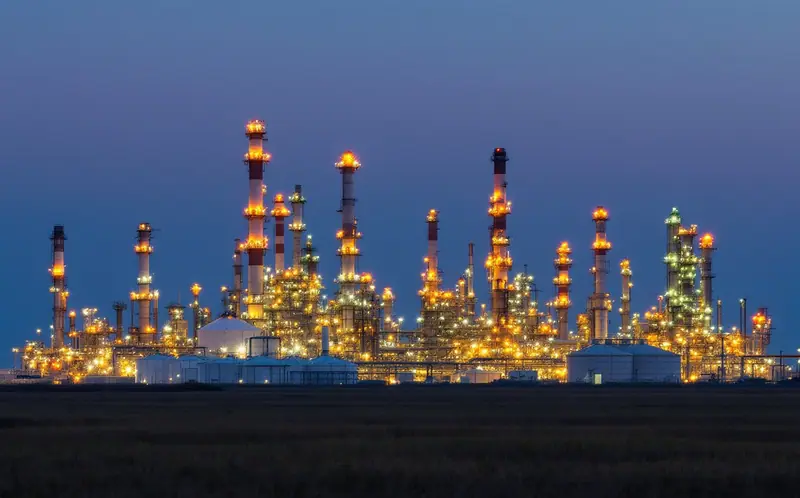
The gas plant is where raw gas turns into pipeline-quality gas. The EIA lists the main steps: separation of liquids, dehydration to take out water, removal of contaminants, nitrogen extraction where needed, and fractionation of the natural gas liquids into separate products.
The order varies by plant, but the logic is consistent.
- Inlet separation. Slugs of liquid that made it through the gathering system drop out in inlet separators or slug catchers.
- Sweetening. If the gas is sour, an amine unit removes the hydrogen sulfide and carbon dioxide. The gas bubbles up through a tower while a liquid amine solution flows down and absorbs the acid gases. The amine is then heated in a second tower to release them, and it goes back around. In sour gas country the hydrogen sulfide is often sent to a sulfur recovery unit, which is why yellow sulfur blocks and sulfur loading facilities are a familiar sight at some Alberta plants.
- Dehydration. A glycol unit works much like the amine unit, only the liquid in the tower is glycol and the thing it pulls out is water. Dry gas is far less likely to form hydrates or corrode steel.
- Liquids recovery. The gas is chilled, sometimes to very low temperatures, so the heavier hydrocarbons condense. Some ethane is often left in the gas, depending on how the plant is set up.
- Fractionation. The recovered liquids go to a train of distillation columns that split them into ethane, propane, butanes and natural gasoline. Some plants do this on site. Others send a mixed liquids stream down a pipeline to a central fractionator.
What leaves the plant is dry natural gas, overwhelmingly methane, at a pressure high enough to enter the transmission system. The liquids leave by their own pipelines, trucks or rail cars.
Transmission: the long-distance pipe
Transmission pipelines are the interstate highways of the system. The EIA calls them wide-diameter, high-pressure lines that move gas from producing and processing areas to storage and distribution centers. In the United States it separates them into interstate lines, which cross state borders, intrastate lines, which stay within one state, and a third type called Hinshaw pipelines, which take gas from interstate lines and deliver it within a single state.
The EIA puts the whole US network at about 3 million miles of mainline and other pipelines, and reports that it delivered about 29.2 trillion cubic feet of gas to about 78.3 million customers in 2022. About half of the mainline network was built in the 1950s and 1960s, when gas demand roughly doubled after the Second World War, so some of the steel in service is older than most of the people who maintain it.
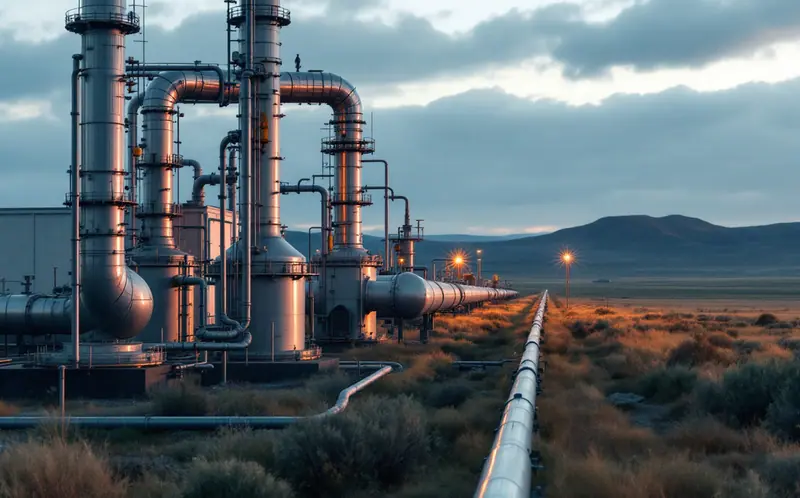
Gas does not flow down a long pipe by itself. Friction against the pipe wall eats pressure every kilometer. Compressor stations along the route, usually driven by gas turbines or large engines, boost the pressure again. A compressor station is a fenced compound with one or more large buildings, a tangle of yard piping, coolers, metering and a blowdown stack. Between stations you will see the pipeline only as a cleared right-of-way, line markers and the occasional valve site. Some of the most interesting kit on a trade show floor serves this part of the chain, and our guide to the supply chain by product category sorts those suppliers into groups.
Storage: the shock absorber
Gas demand swings by the hour and by the season. A cold snap can push heating demand far above summer levels, while production and pipeline flows change slowly. Storage fills the gap, taking gas in when demand is low and sending it out when demand peaks.
The EIA names three main types of underground storage.
- Depleted oil and gas fields. These hold most of the US storage volume.
- Salt caverns. Operators dissolve out a cavity in a salt dome or a bedded salt layer with water, then use the cavity as a tank. Caverns can switch between injection and withdrawal quickly, which suits short, sharp demand spikes. Many sit near the US Gulf Coast.
- Aquifers. Water-bearing rock capped by an impermeable layer can be turned into storage by pushing the water back with gas. This is more common in the US Midwest.
Smaller volumes go into tanks above or below ground, including LNG storage at some utilities.
The city gate and local distribution
The handover from the long-distance pipeline to the local gas utility happens at the city gate. The EIA glossary defines it as a point or measuring station where a distributing gas utility receives gas from a pipeline company or transmission system. Three things happen there. The gas is metered, because ownership and billing change hands at that point. The pressure is cut down to suit the smaller pipes downstream. And in most places the gas is odorized.
Methane has no smell of its own. Utilities add an odorant, usually a sulfur compound from the mercaptan family, so that a leak smells like rotten eggs. In the US the federal pipeline safety rule for distribution lines, 49 CFR 192.625, requires that gas be readily detectable by a person with a normal sense of smell at a concentration of one fifth of the lower explosive limit. Operators must also sample the gas periodically to confirm the odorant is doing its job.
From the city gate the gas flows into distribution mains under the streets, then into service lines to each building, then through a regulator and a meter at the wall.
Who burns it
The EIA groups US consumption into five end-use sectors: electric power, industrial, residential, commercial and transportation. In recent EIA figures electric power generation is the largest single user, with industry close behind. Homes and commercial buildings use most of their gas for space and water heating, which is why demand peaks in winter. Transportation is a small slice and is mostly the gas burned to run the compressors that move gas through pipelines.
There is one more outlet: export. Some gas leaves by pipeline across a border, and some is cooled to a liquid at an LNG terminal and loaded onto a ship. LNG is a whole chain of its own, with its own trains, tanks and carriers.
The value chain at a glance
| Stage | What happens to the gas | Typical equipment |
|---|---|---|
| Wellsite | Free water and liquids separated, gas measured | Wellhead, separator, line heater, meter |
| Gathering | Gas from many wells collected and moved to a plant | Small-diameter flowlines, field compressors |
| Processing | Acid gas, water and natural gas liquids removed | Slug catcher, amine unit, glycol unit, chiller, fractionation towers |
| Transmission | Dry gas moved long distances at high pressure | Large-diameter pipe, compressor stations, block valves |
| Storage | Gas held for peak demand | Depleted fields, salt caverns, aquifers, tanks |
| City gate | Gas metered, pressure cut, odorant added | Meter station, regulators, odorizer |
| Distribution | Gas carried to buildings | Mains, service lines, regulators, customer meters |
| End use | Gas burned for power, heat or as a feedstock | Turbines, boilers, furnaces, burners |
Units: Mcf, MMBtu and GJ
Gas is sold and reported two ways, by volume and by energy, and people often switch between them in the same sentence.
Volume in North America is counted in cubic feet. An Mcf is a thousand cubic feet (the M is the Roman numeral for a thousand, not mega), an MMcf is a million and a Bcf is a billion. National totals run to trillions of cubic feet, written Tcf.
Energy is what a buyer actually wants. The British thermal unit, or Btu, is the heat needed to raise one pound of water by one degree Fahrenheit. The EIA uses a conversion of about 1,036 Btu in a cubic foot of US natural gas, a figure it recalculates every year because gas from different fields carries slightly different heat content. A therm is 100,000 Btu, and US household bills often use it. An MMBtu is a million Btu, roughly the energy in one Mcf of gas.
Canada and most of the rest of the world use metric units. Volume is in cubic meters and energy in joules. Alberta and British Columbia commonly bill and trade gas by the gigajoule, a billion joules. The Canada Energy Regulator's conversion tables put one GJ at about 0.948 MMBtu, so the two units are close but not interchangeable.
A worked example, with illustrative numbers
Say a house burns 100 Mcf of gas in a year. That figure is round and made up for the example, not a typical value for any region.
- Energy in MMBtu: 100 Mcf multiplied by about 1.036 MMBtu per Mcf gives about 103.6 MMBtu.
- Energy in therms: 103.6 MMBtu is 103,600,000 Btu, and dividing by 100,000 gives about 1,036 therms.
- Energy in gigajoules: 103.6 MMBtu divided by 0.948 gives about 109 GJ.
When a report from Calgary and one from Houston seem to disagree, check the units first.
What to take away
Each step in the chain exists to fix one problem. The separator handles liquids, the gas plant handles contaminants, compressors handle distance, storage handles the calendar and the city gate handles safety and billing. The EIA's page on natural gas delivery and storage is a good next read, and the rest of the natural gas and LNG hall picks up the parts this piece only touched. If you ever stand at a compressor station fence and wonder what the noise is for, the answer is nearly always the same: the gas has lost pressure, and somebody has to give it back.

Ingrid Solheim
Ingrid grew up in Stavanger and has lived on both sides of the North Sea. She covers natural gas, LNG and offshore work, with a soft spot for compressors and the ships that carry gas across oceans.