Hall A · Drilling & Completions
How a land drilling rig works, from the derrick to the mud pits
A plain walk around a land drilling rig: the hoisting, rotating, circulating, power and well control systems, the crew who run them, and one connection.
 By Lorne Halvorsen10 min read
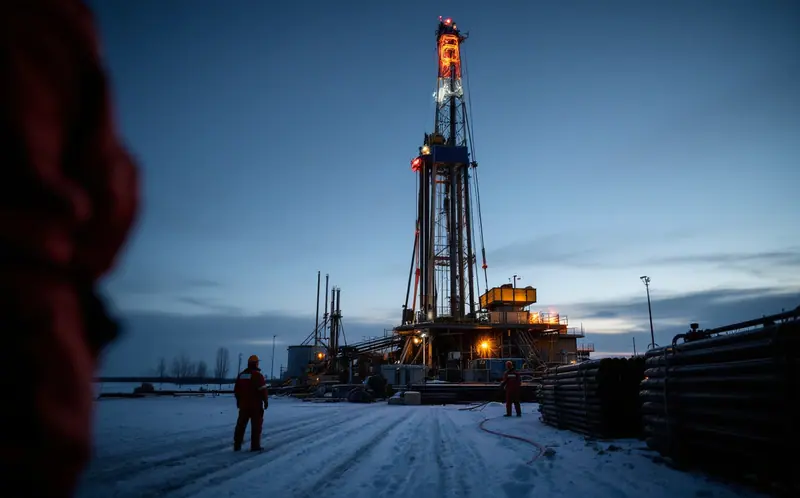
The first time most people see a land rig up close, it looks like a pile of steel that somebody stood on end and wired to a generator. Then you watch a crew make a connection in a couple of minutes, and you start to see that every piece of that pile has one job. This piece walks around a typical land rig system by system and finishes with one connection broken down step by step.
A rig does three things over and over: it turns a bit at the bottom of a long string of pipe, it pumps fluid down that pipe and back up the hole to carry the rock cuttings out, and it lifts and lowers that whole string when the bit needs changing or the hole needs casing. Everything else on location is there to power those three jobs or to keep the well under control while they happen.
Walking onto the lease
Before you reach the rig you pass a row of trailers: the rig manager's office, the operator's office, a change room. Then come the pipe racks, where joints of drill pipe and casing lie waiting, and the catwalk, the ramp that carries pipe up to the rig floor.
The rig sits on a substructure, a steel base that raises the floor high enough for the well control equipment to fit underneath. Beside the floor is the doghouse, where the driller's controls, the paperwork and the coffee usually live. Off to one side are the mud tanks and pumps, and farther out the engines, the fuel tanks and the tanks for drilling waste.
The hoisting system: mast, drawworks and blocks
The tall part everybody photographs is the mast or derrick. On most land rigs it is a mast that is laid down for moving and raised in one piece at the next lease. Its job is to hold up the hoisting equipment and to give the crew somewhere to stand pipe when they pull it out of the hole.
At the top of the mast sits the crown block, a set of fixed sheaves (pulleys). Hanging below it is the traveling block, another set of sheaves that moves up and down. A heavy wire rope called the drill line runs back and forth between the two, which is what gives the rig the mechanical advantage to lift a string of pipe that can weigh hundreds of tonnes.
The drill line ends on the drawworks, a big steel drum with brakes and a power source, mounted on or beside the rig floor. When the driller spools line onto the drum, the traveling block goes up. When the driller lets line off, it goes down. Think of it as a giant winch and pulley set, with the driller's hand on the brake.
The rotating system: top drive or kelly
Older rigs, and plenty of smaller ones still working, use a rotary table and a kelly. The rotary table is a turntable set into the rig floor. The kelly is a square or six-sided length of pipe that passes through a bushing in that table, so when the table turns, the kelly turns, and so does all the pipe screwed onto the bottom of it.
Most newer land rigs use a top drive instead. A top drive is a motor that hangs from the traveling block and screws straight onto the top of the drill string. Because it rides up and down the mast, it can turn the pipe and pump through it at almost any height. That lets the crew drill down a full stand of three joints at a time instead of one joint, and it lets the driller rotate and circulate while pulling pipe if the hole gets sticky.
Below hangs the drill string: drill pipe, then the bottomhole assembly of heavy drill collars, stabilizers and, on directional wells, a mud motor and survey tools.
The circulating system: pumps, standpipe, shakers and pits
Drilling fluid, called mud whatever it is made of, does several jobs at once: it carries cuttings up the hole, cools and cleans the bit, and its weight holds back the pressure of fluids in the rock.
The mud pumps, big piston pumps usually mounted on skids near the tanks, push mud at high pressure into a steel pipe called the standpipe, which runs up the side of the mast. From there a flexible high pressure hose carries it to the top drive or the swivel on top of the kelly, then down the inside of the drill pipe, out through nozzles in the bit, and back up the annulus, the gap between the pipe and the wall of the hole.
At the surface the returning mud, now full of rock, runs over the shale shakers, vibrating screens that catch the cuttings and drop them into a bin or trough. Finer solids come out in desanders and desilters (cone-shaped hydrocyclones), and a degasser pulls out any gas the mud picked up. The cleaned mud goes back to the mud tanks, also called the pits, where the derrickhand checks its weight and properties and mixes in what it needs before the pumps pick it up again.
Watching the level in those pits is one of the most important habits on a rig. If more mud comes back than went down, something from the formation may be pushing its way into the hole.
Power: engines, generators and fuel
Land rigs usually run on a row of big engines, traditionally diesel. Many rigs now run engines on natural gas or on a blend of gas and diesel where a supply is available, and some connect to the electrical grid.
On a mechanical rig, the engines drive the drawworks, the rotary table and the pumps through chains and a compound. On an electric rig, the engines turn generators, and the electricity runs motors on each piece of equipment, which gives the driller finer control from the console.
Well control: the BOP stack and accumulator
Under the rig floor, bolted on top of the wellhead, is the blowout preventer stack, or BOP. It is a set of large valves stacked one above another. Usually there is an annular preventer on top, a rubber packing element that a hydraulic piston squeezes around whatever is in the hole. Below it sit ram preventers: pipe rams that close around the drill pipe, and blind or shear rams that close across an open hole or cut through pipe and seal it.
The BOPs are closed hydraulically. A unit called the accumulator, usually set back from the wellhead, stores hydraulic fluid under pressure in a bank of bottles so the preventers can close even if the rig's power fails. Lines from the stack run to a choke manifold, where the crew can let fluid out of the well under control while heavier mud is pumped in.
The reason all of this exists is the kick, an influx of oil, gas or water from the formation into the wellbore. Caught early and handled by a trained crew, a kick is a problem to manage. Missed, it can become a blowout. In Alberta, the Alberta Energy Regulator sets blowout prevention requirements in Directive 036, and its drilling overview lists the rules that apply to a well from spud to rig release. Well control is a subject with its own training and certification, and nothing here replaces it.
The rig's main systems at a glance
| System | Main equipment | What it does |
|---|---|---|
| Hoisting | Mast or derrick, crown block, traveling block, drill line, drawworks | Lifts and lowers the drill string and casing |
| Rotating | Top drive, or rotary table and kelly | Turns the drill string and bit |
| Circulating | Mud pumps, standpipe, hose, shale shakers, desanders, degasser, mud tanks | Moves drilling fluid down the pipe and up the hole, cleans it, controls pressure |
| Power | Diesel, natural gas or bi-fuel engines, generators, grid tie-in on some sites | Drives everything else |
| Well control | BOP stack, accumulator, choke manifold | Seals the well and controls a kick |
| Pipe handling | Catwalk, pipe racks, elevators, slips, tongs or iron roughneck | Moves pipe to the floor and makes up or breaks out joints |
Who does what on the crew
A drilling crew on a land rig is small, and the names vary a little from company to company. In Alberta the rig technician apprenticeship maps the ranks fairly well: people start as leasehands and floorhands, move up through motorhand and derrickhand, and the top level is driller.
The leasehand keeps the location clean, helps with whatever needs a spare pair of hands and learns the rig from the ground up. Floorhands, often called roughnecks, work on the rig floor handling pipe, setting slips and running tongs. The motorhand looks after engines and mechanical equipment and usually leads the floor crew. The derrickhand works up the mast on the monkey board during trips, guiding stands of pipe in and out of the racking fingers, and runs the mud system and pumps the rest of the time. The driller operates the drawworks, the top drive and the pumps from the console and is in charge of the crew on that shift.
Above the crews sits the rig manager, still called the toolpush on many sites, who is responsible for the rig and all its shifts. Representing the oil company that owns the well is the wellsite supervisor, known on most leases by the old title of company man, who decides what gets drilled and how.
Tripping pipe
Tripping means pulling the whole drill string out of the hole, or running it back in. Crews trip to change a bit or the bottomhole assembly, or to run casing.
Pulling out, the driller lifts the string until a stand is above the floor. A stand is two or three joints left screwed together, and most medium and deep land rigs handle three-joint stands. Each joint of common drill pipe runs about 27 to 32 feet, so a triple stand is roughly 27 m (90 ft) tall. The floorhands set the slips, wedge-shaped grips that hold the rest of the string in the rotary, then break the connection with tongs or an iron roughneck. The derrickhand, up on the monkey board, swings the top of the stand into the fingerboard while the floor crew walks the bottom onto the setback area.
Running in is the same work in reverse. On a deep well a trip can take most of a shift, which is why a bit that lasts longer is worth so much to a drilling program.
Worked example: one connection, step by step
When drilling with a top drive, the crew adds a new stand each time the top drive gets close to the rig floor. Here is one connection in order. The sequence is typical; every company has its own written procedure, and crews follow that.
- The driller drills the stand down until the top drive is near the floor, then stops rotating and usually circulates for a short time to clean cuttings away from the bit.
- The driller picks the string up slightly off bottom, shuts down or slows the pumps, and lowers it until a tool joint sits at a comfortable working height.
- The floorhands set the slips. The weight of the string is now hanging in the rotary table, not on the top drive.
- The top drive or an iron roughneck breaks the connection between the top drive and the string, and the driller lifts the top drive clear.
- The derrickhand on the monkey board releases the next stand from the fingerboard and the floor crew guides it to the well center. With a top drive the stand is latched in the elevators and hoisted into position.
- The crew stabs the bottom of the new stand into the box of the pipe in the slips. Spinning wrenches or the iron roughneck spin it in, and torque is applied to the specified value.
- The top drive screws into the top of the new stand and is torqued up.
- The driller picks up, the floorhands pull the slips, and the driller brings the pumps back up to rate, watching the standpipe pressure.
- The driller eases the bit back to bottom, starts rotation, puts weight on the bit, and drilling resumes. Someone writes down the depth and the time.
On a good crew that takes a few minutes. On a rig with a kelly, the same steps happen for every single joint, with the extra job of picking the new joint out of the mousehole, a short hole beside the rotary where it waits.
Reading more
The drilling and completions hall collects our articles on rigs and wells, and the guide to reading an exhibition floor explains where rig equipment makers usually sit at a big show. If you ever tour a rig, stay with your guide, wear the PPE you are handed, and stand at the doghouse window: you can watch the console and the floor at once, and you will see most of this article in ten minutes.

Lorne Halvorsen
Lorne lives outside Red Deer, Alberta, and has spent most of his working life around rigs and service crews in the Western Canadian basin. He writes about drilling, completions and heavy oil in the plain terms he wishes someone had used with him.