Hall A · Drilling & Completions
Hydraulic fracturing in stages: plug-and-perf, sand and flowback
How a horizontal well is fractured one stage at a time: plug-and-perf and sliding sleeves, the frac spread, fluid and sand, pressure watching and flowback.
 By Lorne Halvorsen10 min read
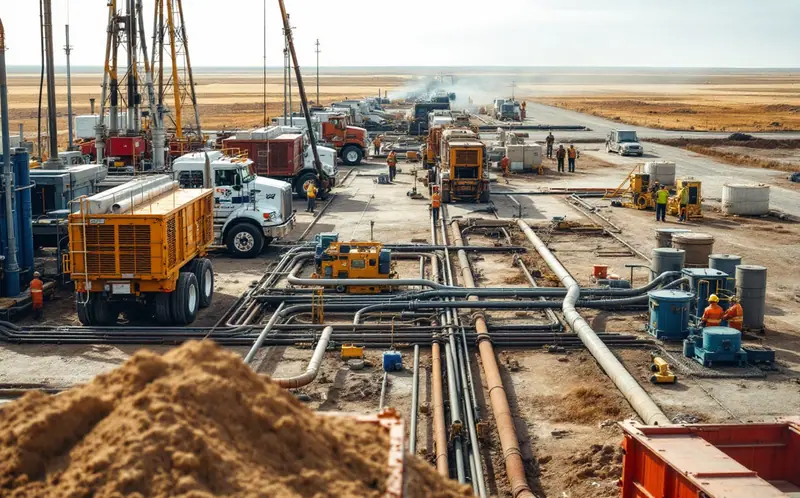
A frac spread looks like a truck stop that lost its way. Twenty or more big units parked in rows on a well pad, hoses and steel lines snaking between them, sand containers stacked at one end, a control van humming at the other, and in the middle of it all a wellhead dressed up in valves several storeys high. Then the pumps come up to rate and the noise tells you this is not a parking lot.
Hydraulic fracturing is the part of completing a well where fluid and sand are pumped down at high pressure to crack the rock and prop those cracks open, so oil or gas can flow from tight rock into the wellbore. On a modern horizontal well it is not done all at once. It is done in stages, one section of the horizontal at a time, working from the far end back toward the vertical. This piece walks through how that works, compares the two common ways of isolating stages, and breaks down one stage from start to finish.
Why the well is horizontal and why it is staged
Shale and other tight rocks hold a lot of oil and gas but let it move very slowly. A vertical well through a thin layer of shale touches only a few metres of it. A horizontal well drilled along the layer can touch hundreds or thousands of metres of it. The US Energy Information Administration notes that the horizontal section, the lateral, can run from a few hundred feet to several miles, and that by 2016 wells that were both horizontally drilled and hydraulically fractured made up about 69 per cent of the oil and gas wells drilled in the United States.
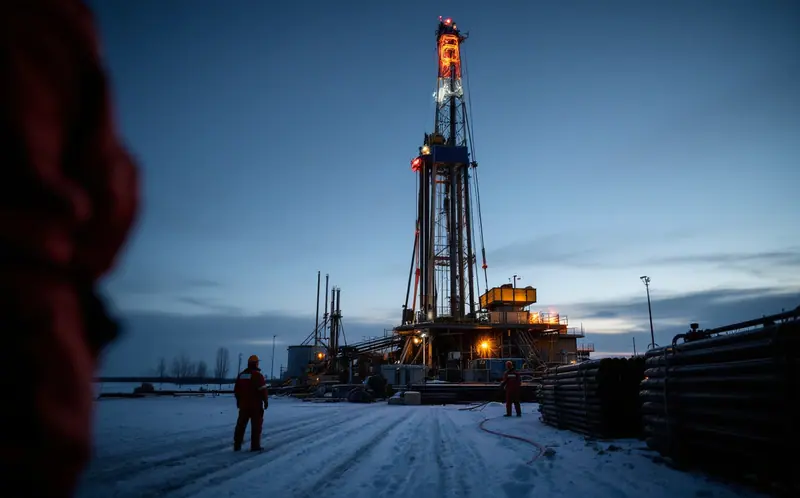
A long lateral cannot be fractured well in one go. Pump into the whole thing at once and the fluid goes where the rock is weakest, leaving most of the lateral untouched. So the lateral is split into stages, each a short section that is isolated from the rest, perforated and fractured on its own. The rig that drilled the well, the kind of machine described in our piece on how a land drilling rig works, has usually moved off by now. Completions crews take over the pad.
Two ways to isolate a stage
There are two common systems, and the choice is made before the casing goes in the hole.
Plug-and-perf
In plug-and-perf, the lateral is cased and cemented as a plain steel pipe. To start, a wireline crew perforates the casing near the toe, the far end of the well, using shaped charges in a perforating gun that blast holes through the casing and cement into the rock. The frac crew pumps that first stage. Then wireline runs back in with a plug and a fresh set of guns. The plug is set in the casing just behind the stage that was fractured, sealing it off, and the guns perforate the next section. Pump, plug, perforate, and repeat, stage after stage, back toward the heel.
When all the stages are done, the plugs have to come out, usually by drilling them up with coiled tubing or a workover unit, unless the operator used dissolvable plugs designed to break down in the well fluid.
Sliding sleeves
With sliding sleeves, the ports are built into the casing or liner before it goes in, spaced along the lateral and closed. The stages are opened one at a time, usually by dropping a ball or running a shifting tool that slides a sleeve open, which exposes that section and isolates the one below it. Wireline is usually not needed between stages, which can save time, but the number and position of the stages are fixed once the string is in the hole.
| Plug-and-perf | Sliding sleeves | |
|---|---|---|
| Casing | Plain cemented casing | Casing or liner with sleeves built in |
| How a stage is opened | Wireline perforating guns | Ball drop or shifting tool opens a sleeve |
| How the stage below is sealed | Plug set by wireline | Sleeve or seat isolates it |
| Flexibility | Stage spacing can change on the day | Spacing fixed when the string is run |
| After the job | Plugs drilled out or dissolve | Seats may be milled out, sleeves can stay |
The rest of this piece uses plug-and-perf as the example.
What you are looking at on a frac pad
If you get a chance to see a frac from a safe distance, the equipment falls into groups.
The water side comes first: tanks, a pit or a line from a water source, and transfer pumps. Next to it are the sand units, either silos or stacks of containers, feeding sand on conveyors to the blender. The blender is where water, sand and chemical additives are mixed into slurry at the rates the engineer calls for. Chemical additive units sit beside it.
From the blender, low-pressure hoses feed the pump units, the big triplex or quintuplex pumps that make up most of the spread. They raise the slurry to treating pressure and send it into a manifold, sometimes called the missile, and from there through heavy steel high-pressure lines, the iron, to the frac tree on the wellhead.
The data van, or control room, sits off to the side. Inside it the treating engineer and the frac supervisor watch screens showing rates, pressures, sand concentration and volumes for every unit in real time. A wireline truck with its crane or mast sits near the wellhead for plug-and-perf work, and on pads with several wells there may be a second wellhead being prepared while the first is pumped.
Because the iron carries fluid at very high pressure, everything between the pumps and the wellhead is a restricted area while pumping, and nobody walks into it without the supervisor's say-so. Gas, including hydrogen sulfide in some areas, can also come back during flowback, which is why the site gas monitoring covered in our piece on H2S on site applies here too.
Fluid and proppant
Most of what goes down the hole is water and sand. FracFocus, the US disclosure registry, says most fracturing fluid formulas are 98 to 99 per cent water and sand, with 0.5 to 2 per cent chemical additives. The sand, or a manufactured ceramic of similar size, is the proppant: it stays in the cracks after the pumps stop and holds them open.
The additives each have a job. FracFocus lists, among others:
- friction reducer, so the fluid can be pumped faster down the pipe
- gelling agents and crosslinkers, which thicken the fluid so it can carry more sand
- breakers, which thin the gel again afterward so it flows back
- acid, to clean up near the perforations and help start fractures
- biocide, to stop bacteria growing in the well
- scale and corrosion inhibitors and clay control
Many shale jobs use a thin "slickwater" fluid that relies mostly on friction reducer and high pump rates instead of thick gels.
Worked example: one plug-and-perf stage
Here is one stage, start to finish. The order is typical; the volumes, rates and pressures vary from well to well, so none are given. Every company runs to its own written procedure and job design.
- Wireline rigs up on the wellhead and runs a tool string into the well with a plug at the bottom and perforating guns above it. Fluid is pumped behind the tools to carry them down the horizontal.
- With the tools at depth, the crew sets the plug just behind the last stage pumped, isolating it.
- The guns are pulled up to the planned depths and fired in clusters, putting several groups of holes through the casing along the new stage.
- Wireline pulls out of the hole and the wellhead valves are lined up for pumping.
- The pumps come up, and the treating pressure climbs until the rock at the perforations breaks down. The engineer watches for that drop.
- A pad of fluid without sand is pumped to open and extend the fractures.
- Sand goes in, usually starting at a low concentration and stepping up through the stage as the fractures grow.
- A flush of clean fluid pushes the last of the sand out of the casing and into the fractures, so it does not settle in the pipe.
- The pumps stop. The engineer records the shut-in pressure, which says something about how the rock and fractures responded.
- Wireline rigs back up for the next stage, and the cycle starts again.
A long lateral can hold dozens of stages, and more than 30 in one horizontal well is not unusual.
Watching the pressure
The treating pressure chart is the closest thing a frac has to a heartbeat. A steady pressure at a steady rate means the fractures are taking fluid and sand the way the design expected. A sharp climb can mean the sand is bridging off at the perforations or in the fracture, a screenout, and the crew may have to cut sand and flush. A sudden fall can mean the fluid has found a weak path somewhere.
On some wells the operator also monitors what is happening in the rock. Microseismic monitoring uses sensitive geophones in a nearby well or at surface to pick up the tiny events made as the rock cracks, giving a rough map of where the fractures went. Pressure gauges on neighbouring wells can show whether a fracture from one well has reached another, which operators call a frac hit.
Zipper fracs on multi-well pads
Most shale wells are now drilled several to a pad, side by side. That lets the frac crew run a zipper frac: while one well is being pumped, wireline is setting the plug and perforating the next stage in the well beside it. When the first well's stage is done, the pumps switch over to the second well and wireline moves back to the first. The two wells alternate stage by stage, like the two sides of a zipper closing, and the pumps spend less time idle waiting for wireline.
Flowback and produced water
When the last stage is pumped and the plugs are dealt with, the well is opened up to flow. The first fluid back is flowback: a mix of the fracturing fluid, some sand, and increasingly over the following days and weeks, water from the formation itself, known as produced water. It goes through a flowback package of sand separators, chokes and tanks on the pad, where it is measured and sampled.
Not all of the fluid comes back. What does is stored, then recycled for the next frac, treated, or disposed of, often by injection into deep disposal wells approved by the regulator. Produced water from many shale formations is very salty, which is why it is handled as an industrial fluid and not as ordinary water.
Rules and disclosure
Fracturing is regulated by the province or state where the well is drilled, and the details differ from place to place. In Alberta, the Alberta Energy Regulator's hydraulic fracturing page points to Directive 083 on subsurface integrity, which covers protecting groundwater and nearby wells, and Directive 059, under which companies report fracturing fluid composition and water sources. The AER also says fluids used above the base of groundwater protection must be nontoxic, and that studies have shown hydraulic fracturing can cause earthquakes in Alberta, which is why some areas have extra seismic rules.
In the United States, FracFocus is the national chemical disclosure registry, launched on April 11, 2011 by the Ground Water Protection Council and the Interstate Oil and Gas Compact Commission. According to FracFocus, 27 states either require or allow companies to report fracturing chemical data through it, and anyone can search the records by location.
A bit of history
Fracturing is older than most people think. After an experimental treatment in the Hugoton gas field in Kansas in 1947, the first commercial fracturing treatments were pumped by Halliburton on March 17, 1949, in Oklahoma and Texas. Those jobs were small single treatments in vertical wells. What changed the industry was pairing fracturing with long horizontal wells and many stages, which is the method this piece describes.
If you want more on completions, wellheads and the crews who run them, the drilling and completions hall collects our articles in one place. The idea to keep is the rhythm of the job: isolate, perforate, pump, flush, and only then move up the hole.

Lorne Halvorsen
Lorne lives outside Red Deer, Alberta, and has spent most of his working life around rigs and service crews in the Western Canadian basin. He writes about drilling, completions and heavy oil in the plain terms he wishes someone had used with him.