Hall A · Drilling & Completions
Blowout preventers: rams, annulars and the stack
A tour of the blowout preventer stack from the annular down to the wellhead: what each ram does, how the accumulator closes them, and how a crew shuts in a kick.
 By Lorne Halvorsen9 min read
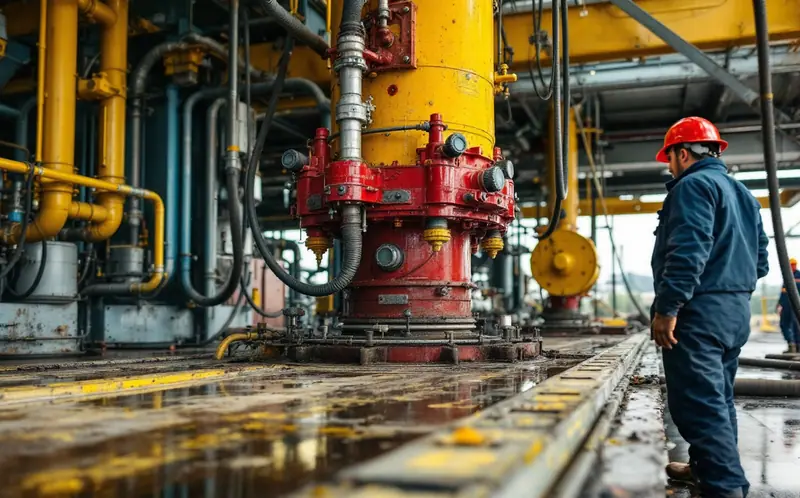
Stand under the floor of a land rig and look at the wellhead, and you will see a column of heavy steel bodies bolted one on top of another, painted in whatever colors the rig contractor likes, with hoses and steel lines coming off it like roots. That column is the blowout preventer stack, the BOP. On most days it does nothing at all. It is there for the few minutes when the well tries to push back harder than the mud can hold, and for those minutes it is the most important piece of steel on location.
This piece walks the stack from the top down, then follows the hydraulics back to the accumulator, then looks at the kick and the shut-in that the whole arrangement is built for. It is general education. Well control has its own courses, certificates and site procedures, and nothing here takes their place.
Why the stack exists at all
The first line of defense on any well is the drilling fluid. A column of mud presses down on the bottom of the hole, and as long as that pressure is greater than the pressure of the oil, gas or water in the rock, those fluids stay where they are. Our piece on how a land drilling rig works shows how the mud gets pumped and cleaned.
When the mud pressure drops below the formation pressure, fluid from the rock flows into the wellbore. That influx is called a kick. The SLB Energy Glossary describes two broad causes: the mud is too light for the pressure it meets, or the movement of pipe in the hole briefly lowers the pressure at the bottom. Pulling pipe too fast can swab the well, a little like pulling a plunger up a syringe.
A kick that is caught early and handled well is a problem to manage. A kick that is missed, or handled badly, can become a blowout: uncontrolled flow to surface. The BOP is the second line of defense, the equipment that lets the crew seal the well at surface and then handle the influx on their own terms.
A tour of the stack, from the top down
Stacks vary with the depth, the pressure expected and the rules in force, so treat this as a common arrangement, not the only one.
The annular preventer
Usually at the top sits the annular preventer, often just called the annular, or by older hands "the bag." Inside it is a thick ring of rubber reinforced with steel ribs. When hydraulic pressure pushes a piston up underneath it, the rubber is squeezed inward and closes around whatever is in the hole: drill pipe, a tool joint, casing, a square kelly, even nothing at all on some designs.
That flexibility is why the annular is often the first thing closed when a kick is detected. It does not care much about the size or shape of the pipe. The tradeoff is that the rubber wears, and annulars are generally rated for lower pressure than the rams below them.
Pipe rams
Below the annular sit one or more ram preventers. A ram preventer works like a gate valve turned on its side: two heavy steel blocks, the rams, are driven toward each other from opposite sides of the bore by hydraulic pistons, and they meet in the middle.
Pipe rams have a half-circle cut in the face of each block, sized to the drill pipe in use, with rubber packing around it. When they close, they seal the annulus, the space between the outside of the pipe and the inside of the wellhead, but they do not seal the inside of the pipe. That is handled by valves in the drill string itself. Variable-bore rams accept a range of pipe sizes, usually at some cost in pressure rating and service life.
Blind rams and shear rams
Blind rams have flat faces with no cutout. They are designed to close across an open hole when no pipe is in the stack. Shear rams have hardened blades meant to cut through pipe. Blind shear rams combine the two jobs: they cut the pipe and then seal the bore. On many stacks they are the last line of defense, used only when nothing else will do.
The drilling spool, choke and kill lines
Somewhere in the stack, often between rams, there are side outlets, either on a separate drilling spool or on the ram bodies themselves. Bolted to these are two lines. The choke line runs to the choke manifold, a set of valves and adjustable chokes off to the side of the rig. The kill line lets the crew pump fluid into the well below the closed preventers.
The wellhead
At the bottom, the whole stack bolts onto the casing head, the first piece of the wellhead that was welded or threaded onto the surface casing. That connection matters more than it looks. The stack is only as good as the casing and cement it sits on, which is why casing depth and cement quality are part of well control planning from the start.
The stack at a glance
| Component | What closes or seals | Typical use |
|---|---|---|
| Annular preventer | Rubber element around any pipe, or open hole on some designs | First closure on a kick, stripping pipe under pressure |
| Pipe rams | Steel rams around one pipe size, sealing the annulus | Holding pressure once the well is shut in |
| Variable-bore rams | Rams that fit a range of pipe sizes | Strings with more than one pipe size |
| Blind rams | Flat rams across an empty bore | Sealing the well with no pipe in the hole |
| Shear or blind shear rams | Blades that cut pipe, and on blind shear rams also seal | Last resort when the well must be sealed with pipe in the way |
| Choke and kill lines | Side outlets with valves | Bleeding fluid out under control, pumping fluid in |
The accumulator: stored pressure for a bad day
Every one of those preventers is closed by hydraulic fluid. If the rig lost power at exactly the wrong moment, a stack that depended on running pumps would be useless. So the hydraulic fluid is stored ahead of time.
The accumulator unit, usually set back some distance from the wellhead on a land rig, holds a bank of steel bottles. Each bottle has a gas charge, commonly nitrogen, on one side of a bladder or float and hydraulic fluid on the other. Electric and air-driven pumps keep the fluid pressured up. When an operator moves a lever on the accumulator or on the remote panel near the driller, valves open and the stored pressure drives fluid to the chosen preventer.
Because the accumulator sits away from the well, it can still be reached if the area around the rig floor becomes unsafe. The remote panel lets the driller act without walking anywhere.
How a crew sees a kick coming
Kicks usually announce themselves before they become dramatic, if somebody is watching. The warning signs taught in well control training are mostly about volume and flow:
- The mud pits gain volume. More fluid is coming out of the hole than is going in.
- Flow from the well increases while the pumps run at a steady rate.
- The well keeps flowing with the pumps off.
- On a trip out, the hole takes less fluid to fill than the volume of steel removed. Wikipedia's well control article gives the example of pulling three barrels of steel and needing only two barrels of mud to fill the hole, a sign that a one-barrel kick may have been swabbed in.
- A sudden change in drilling rate, called a drilling break, can mean the bit has entered a softer, possibly pressured zone.
Watching the trip tank and the pit levels is unglamorous work, and it is a large part of why most kicks never become stories.
A shut-in, in general terms
When the signs point to a kick, the crew follows the shut-in procedure written for that rig and that well. The details belong to the operator and the contractor, and they differ between companies and between land and offshore. The broad shape is usually this:
- Stop drilling, pick the bit up off bottom so a tool joint is clear of the preventer that will close, and stop the pumps.
- Check whether the well is flowing.
- If it is, close a preventer, often the annular first, with the choke line arranged according to the site procedure.
- Call the supervisors and record the pressures at surface: the shut-in drillpipe pressure and the shut-in casing pressure, along with the pit gain.
- Wait for the pressures to stabilize while the supervisors and engineers plan the kill.
Those two pressures tell the people in charge a lot. With the well shut in, the pressure at the bottom of the hole equals the weight of the fluid column plus the pressure at surface. From the shut-in drillpipe pressure and the depth, they can work out how much heavier the mud needs to be to hold the formation back.
Killing the well
Once the well is shut in, the influx has to be circulated out and the hole filled with heavier mud. Drilling crews most often use the Driller's method, which circulates the kick out first with the existing mud and then pumps the heavier kill mud in a second circulation, or the Engineer's method, also called wait and weight, which pumps kill-weight mud from the start. Throughout, the choke operator adjusts the choke to hold the right pressure on the bottom of the hole as gas expands on its way up.
Bullheading, pumping fluid down into the well and pushing the influx back into the formation, is more common in workovers and completions than while drilling.
Testing: proving it works before it is needed
A preventer that has not been tested is a guess. Regulators set testing rules, and they differ by jurisdiction. In Alberta, the Alberta Energy Regulator's Directive 036 sets the minimum blowout prevention equipment and procedures for drilling wells in the province.
For the US offshore, the federal rules at 30 CFR 250.737 give a good picture of what testing involves. BOPs must be pressure tested at installation and at intervals of no more than 14 days. Each pressure test includes a low-pressure test between 250 and 350 psi before the high-pressure test, and each test must hold for 5 minutes. Annular and pipe rams are also function tested, opened and closed without pressure, every 7 days between pressure tests.
On land rigs, crews also run drills: the driller sounds an alarm without warning and the crew goes to their positions as if a kick had been taken. The drill is timed and logged.
Where the ram preventer came from
The ram-type blowout preventer was invented by James Smither Abercrombie and Harry S. Cameron in 1922, in Cameron's machine shop in Humble, Texas, and was brought to market in 1924. The American Society of Mechanical Engineers lists it as a historic mechanical engineering landmark. The spherical annular preventer came later, from Granville Sloan Knox, who invented it in 1946.
The principle has not changed much since. Steel rams meet in the middle, rubber squeezes around pipe, and stored pressure closes them. What has changed is the pressure ratings, the controls and the testing, and the expectation that every person on the floor knows what to do when the pit alarm goes off.
For more on rigs and wells, the drilling and completions hall collects our related articles. If you ever get a rig tour, ask to see the accumulator and the remote panel. Knowing where the stored pressure lives, and who is allowed to use it, tells you a lot about how seriously a rig takes its well control.

Lorne Halvorsen
Lorne lives outside Red Deer, Alberta, and has spent most of his working life around rigs and service crews in the Western Canadian basin. He writes about drilling, completions and heavy oil in the plain terms he wishes someone had used with him.