LNG explained: liquefaction trains, carriers and regasification
How natural gas is cleaned, chilled to about minus 162 C and shrunk 600 times, carried across oceans in insulated tanks and turned back into gas at the far end.
 By Ingrid Solheim9 min read
Natural gas is awkward to move. As a gas it takes up an enormous amount of space, so the usual answer is a pipeline. Pipelines work well across a continent, and badly across an ocean. Liquefied natural gas, LNG, is the industry's way around that problem: cool the gas until it turns into a liquid, put the liquid in a very well insulated ship, and warm it back into gas at the other end.
The idea is simple. The plants and ships that make it work are some of the largest and most carefully engineered objects in the energy business. This piece walks the chain from the gas field to the receiving pipeline, one stage at a time.
The basic numbers
The US Department of Energy and the US Energy Information Administration both describe LNG the same way. It is natural gas cooled to about minus 260 degrees Fahrenheit, which is about minus 162 degrees Celsius, and in liquid form it takes up about 600 times less space than it does as a gas.
At that temperature LNG is stored at close to atmospheric pressure. It is not a compressed gas in a heavy bottle. It is a very cold liquid in a very well insulated tank, boiling gently. That one fact explains most of the design choices further down the chain.
LNG is mostly methane, and it is not stored under pressure, so the main hazards are cold and, if the liquid warms and escapes, flammable gas. Those hazards are why terminals and ships are built with layers of containment, gas detection and strict procedures, and why only trained crews work on the jetties and in the cargo systems.
Step one: getting the gas ready
Gas arriving at a liquefaction plant comes from a field, usually by pipeline. Before it can be chilled it has to be cleaned more thoroughly than pipeline gas normally is. Anything that would freeze at minus 162 degrees, or attack the equipment, has to come out first.
The usual pre-treatment list includes:
- Acid gases. Carbon dioxide would freeze solid and plug the cold equipment, and hydrogen sulfide is toxic and corrosive. An amine unit removes both, much as it does in an ordinary gas plant.
- Water. Even small traces would freeze, so the gas is dried far more thoroughly than ordinary pipeline gas.
- Mercury. It is present in tiny amounts in some gas and can damage the plant's equipment, so it is taken out as well.
- Heavier hydrocarbons. These would freeze out as the gas cools, so they are separated and sold as liquids.
Our piece on the natural gas value chain describes amine and dehydration units in more detail. At an LNG plant they are the same in principle, built to a tighter standard.
Step two: the liquefaction train
A liquefaction train is a self-contained processing line that takes in clean gas and puts out LNG. A large export plant often has several trains side by side, which lets the operator expand in steps and keep producing while one train is down for maintenance.
The core of a train is a refrigeration system. You cannot cool gas to minus 162 degrees in one step with one refrigerant, so plants use cycles that work in stages. Two broad families account for most plants.
- Cascade processes use a series of pure refrigerants, each cooling the gas to a lower temperature than the last. A common sequence is propane first, then ethylene or ethane, then methane for the final step.
- Mixed refrigerant processes use a blend of refrigerants that boils over a range of temperatures as it passes through the main heat exchanger. The most widely used design pre-cools the gas with propane first and then finishes it with the mixed refrigerant.
Either way the train needs very large compressors to drive the refrigerant around, and that takes energy. The EIA estimates that about 7 to 15 percent of the gas fed into a US liquefaction plant is used up in the liquefaction process, mostly to power the plant's own equipment. The EIA notes that US plants mostly drive their compressors with gas turbines, and that one, Freeport LNG, uses electric motors instead.
What you see on site
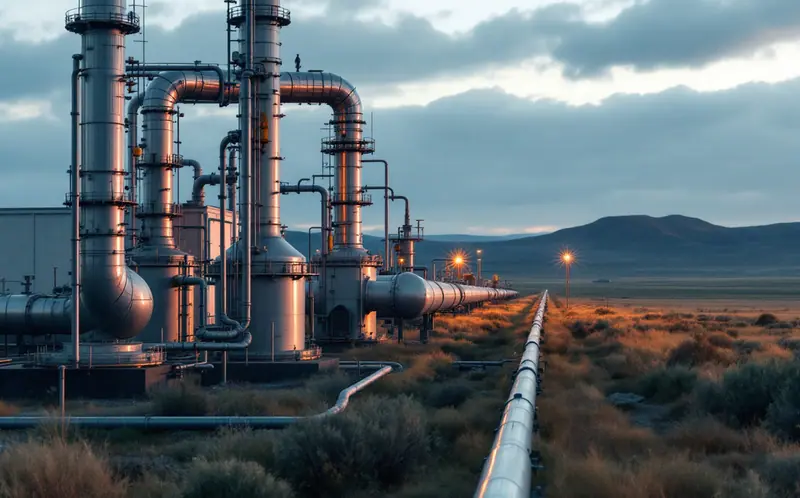
From the fence line, a liquefaction plant looks like a refinery that has been tidied up. There are long pipe racks, tall columns for gas treatment, large air coolers or seawater cooling systems, compressor buildings, a flare, and the tall, slim boxes that hold the main cryogenic heat exchangers. Beyond them are the storage tanks and a jetty running out to deep water.
Step three: storage tanks
Fresh LNG goes into large insulated tanks near the jetty. Modern onshore tanks are commonly of the full containment type: an inner tank of high-nickel steel, which stays tough at very low temperatures, inside an outer wall of prestressed concrete. The space between the two is insulated, and the outer tank is designed to hold the liquid if the inner tank ever leaks.
No insulation is perfect, so a little heat always gets in and a small amount of LNG always boils off. That boil-off gas carries heat away with it, which keeps the rest of the liquid cold. The industry calls this auto-refrigeration. The boil-off cannot simply sit in the tank, so the terminal either compresses it and sends it out as gas, burns it as fuel, or re-liquefies it and puts it back.
Step four: the ship
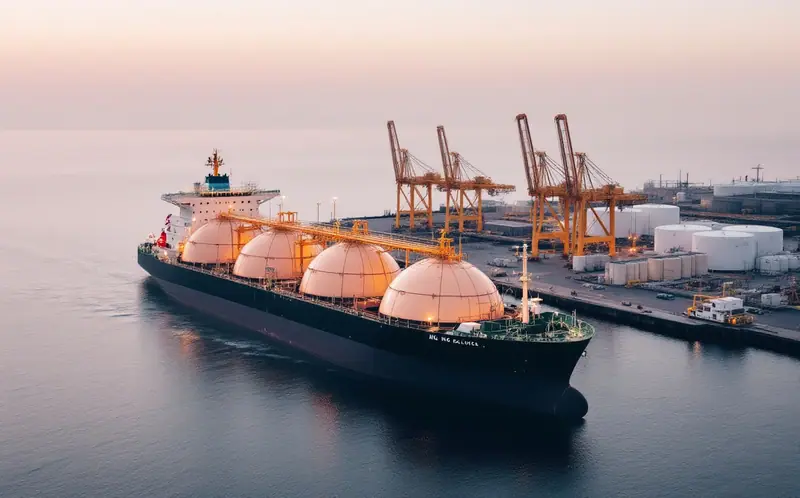
LNG carriers are double-hulled ships with insulated cargo tanks, and they come in two main designs that are easy to tell apart from the dockside.
| Design | What it looks like | How it holds the cargo |
|---|---|---|
| Moss (spherical) | A row of large domes standing above the deck | Self-supporting aluminum spheres resting on supports in the hull |
| Membrane | A flat deck with a long raised trunk, much like an oil tanker | A thin metal barrier lined with insulation, held in place by the ship's own inner hull |
Moss ships are the ones most people picture, because the domes are so distinctive. Membrane designs make better use of the space inside the hull, and the trend in new ships has been toward membrane tanks. Both are designed around the same idea: keep the cargo at minus 162 degrees at near atmospheric pressure for the whole voyage.
Boil-off continues at sea. Ships have traditionally burned it as fuel, first in steam boilers and more recently in engines that can run on gas. Some ships also carry equipment to re-liquefy part of it and return it to the tanks. Either way, the ship arrives with slightly less cargo than it loaded, and that loss is part of the arithmetic of every voyage.
Loading and unloading are done through articulated loading arms on the jetty, with the ship's cargo control room and the terminal working together.
Step five: the receiving terminal and regasification
At the import end the process runs in reverse. The ship pumps its cargo into the terminal's tanks. From there, pumps send the liquid at high pressure to vaporizers, where it is warmed back into gas. In many conventional terminals the heat comes from seawater. The gas is metered and sent into the pipeline system, where it becomes ordinary pipeline gas serving power plants, factories and homes.
The DOE also mentions small-scale LNG: trucks with cryogenic tanks that carry LNG to customers off the pipeline grid, and peak-shaving plants that liquefy pipeline gas in quiet periods and store it on site for cold days.
FSRUs: the terminal on a ship
Building a full onshore import terminal takes years. A faster route is the floating storage and regasification unit, or FSRU: a ship, or a ship-like vessel, that stores LNG and carries the vaporizers on board. It moors at a jetty or offshore buoy, LNG carriers unload into it, and it sends gas ashore by pipeline. Because it floats, it can be moved to another location if business needs change.
The EIA noted that many new European import projects after 2021 relied on chartering FSRUs because they could be brought into service quickly. In Germany, which had not imported LNG before, the FSRU terminal at Wilhelmshaven was completed in November 2022, and the country received its first LNG in January 2023.
Pipeline gas and LNG compared
| Point | Pipeline gas | LNG |
|---|---|---|
| State | Gas under pressure | Liquid at about minus 162 C, near atmospheric pressure |
| Typical distance | Across a continent | Across an ocean |
| Route | Fixed, follows the pipe | Flexible, ships can go to any terminal that can receive them |
| Main energy cost in transport | Compressor stations along the line | Liquefaction, plus boil-off on the voyage |
| Key equipment | Pipe, compressor stations, meter stations | Treatment units, liquefaction trains, tanks, carriers, vaporizers |
| Arrives as | Gas, ready to use | Liquid, must be regasified |
A worked example, with illustrative numbers
These numbers are round and made up to show the arithmetic. They do not describe any real ship or plant.
Say a carrier loads 150,000 cubic meters of LNG. Using the 600 to 1 ratio from the DOE, that is roughly 150,000 multiplied by 600, or 90 million cubic meters of gas once it is warmed back up.
Now say the voyage takes 15 days and, for the sake of the example, 0.1 percent of the cargo boils off each day. That is 150 cubic meters of liquid a day, or about 2,250 cubic meters over the voyage. In gas terms, that is about 1.35 million cubic meters, burned as fuel or re-liquefied rather than delivered.
Before the gas even reached the ship, the liquefaction plant used some of its own feed. Using the low end of the EIA's 7 to 15 percent range, a plant would have taken in roughly 7 percent more gas than it turned into LNG. The real figures depend on the plant, the ship and the route, but the pattern is the same: LNG pays for its flexibility in energy at every step.
Where the US fits
For years the United States was an LNG importer. The EIA puts the peak of those imports in 2007, and the small volumes still imported go mainly to New England. The shale gas boom turned the trade around. The DOE records that the first export of LNG produced in the lower 48 states left the Sabine Pass terminal in Louisiana in February 2016, and the EIA reports that the country was a net LNG exporter in every year from 2016 through 2023. Companies that want to export gas from the US need authorization from the DOE's Office of Fossil Energy and Carbon Management, while the Federal Energy Regulatory Commission generally oversees the siting, construction and operation of the terminals. The DOE's own LNG overview explains that process, and the EIA's LNG explainer has the trade figures.
What to remember
The chain has five links: treat, liquefy, store, ship and regasify. Each one exists to handle the same awkward facts, that LNG is extremely cold, boils at the slightest warmth and has to be turned back into gas before anyone can use it. When you next see a Moss carrier on the horizon or a white tank farm by a harbor, look for the jetty and the vaporizers. They tell you which end of the chain you are standing at. More on gas processing, compression and storage is in the natural gas and LNG hall.

Ingrid Solheim
Ingrid grew up in Stavanger and has lived on both sides of the North Sea. She covers natural gas, LNG and offshore work, with a soft spot for compressors and the ships that carry gas across oceans.