Hall B · Heavy Oil & Oil Sands
SAGD explained: how steam brings bitumen up from the oil sands
How steam-assisted gravity drainage works: why bitumen needs heat, how the well pairs sit, how the steam chamber grows and what the plant does with the water.
 By Lorne Halvorsen9 min read
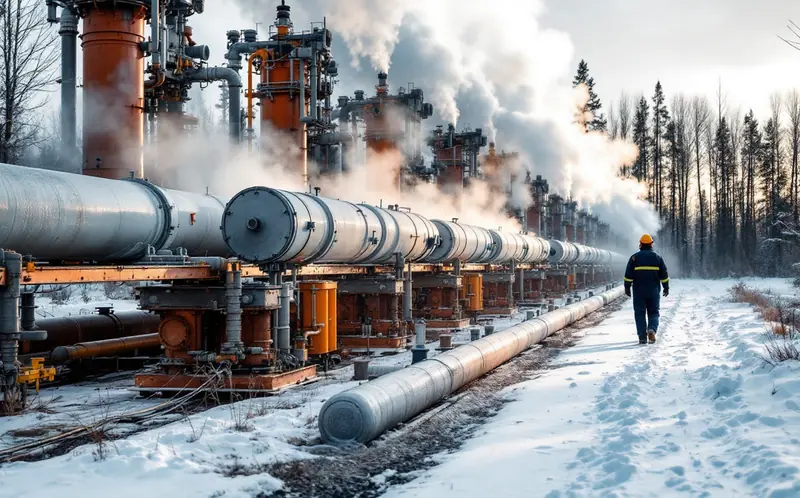
Drive north from Edmonton toward Fort McMurray or east toward Cold Lake and you will pass plenty of oil sands operations that look nothing like the giant mines in the photographs. What you see instead is a gravel pad in the trees, a neat row of wellheads, a lot of insulated pipe on racks, and in the distance a plant with stacks and tanks. That is what most oil sands production looks like now, and the process behind it is called steam-assisted gravity drainage, or SAGD (most people say "sag-dee").
This piece explains why the oil sands need steam at all, how a SAGD well pair is laid out, what happens underground as the steam chamber grows, and what the central plant does with the oil and water that come back. There is a worked example of the steam-to-oil ratio partway through, with round numbers that are illustrative only.
Why bitumen needs heat
The oil in the oil sands is bitumen, an extra-heavy oil that at reservoir temperature is about as runny as cold peanut butter. Conventional oil flows to a well on its own, pushed by reservoir pressure. Bitumen will not. You can drill a well into it, open the valve and get almost nothing.
What changes that is temperature. Heat bitumen enough and its viscosity drops by orders of magnitude, until it flows like a heavy motor oil. Every in situ method in the oil sands is a way of getting heat, or sometimes a solvent, into the reservoir so the bitumen can move to a well. "In situ" is Latin for "in place": the oil is separated from the sand underground, not dug up and washed at the surface.
How much of the resource needs that approach is the reason SAGD matters. According to the Alberta Energy Regulator, around 80 per cent of the oil in Alberta's oil sands is buried too deep to mine and can be recovered only by drilling wells. The Government of Alberta's oil sands facts page puts the depth limit for mining at about 75 m, a depth reached only in the Athabasca area, and the mineable area at about 4,800 square kilometres out of roughly 142,200 underlain by oil sands. Everything else has to be produced from wells.
The well pair
The heart of SAGD is two horizontal wells drilled one above the other. The AER describes them as about five metres apart. The upper well is the injector: steam goes down it and out into the reservoir. The lower well is the producer: heated bitumen and condensed steam drain down to it and are pumped or lifted to surface.
Both wells start vertical from a pad at surface, then curve over until they run horizontally near the base of the bitumen-bearing sand. The horizontal sections are hundreds of metres long, and a pad usually has a row of well pairs drilled side by side, like the teeth of a comb, so one pad can drain a wide block of reservoir. Drilling them takes the same kind of rig and the same hoisting and circulating systems described in our piece on how a land drilling rig works, with directional tools steering the two wells so they stay parallel over their whole length.
Placing the producer near the bottom of the pay matters. Anything below it will not drain to it, so drillers try to keep it as low in the good sand as they can.
Start-up: warming the gap
When a new pair goes on, the five-metre gap between the wells is full of cold bitumen that will not move. So the operator first circulates steam through both wells for a period, heating the rock between them by conduction until the bitumen there can flow. Once the two wells are in communication, the operator switches to normal SAGD: steam into the top well only, and production from the bottom well only.
How the steam chamber grows
This is the part that gives the process its name. Steam injected from the upper well rises, because it is lighter than anything else down there, and forms a growing zone of hot, steam-filled rock called the steam chamber. At the edges of that chamber the steam gives up its heat to the cold bitumen and condenses into hot water.
The warmed bitumen and the condensed water then drain downward along the edge of the chamber, by gravity, to the producer below. As oil leaves the pore space, steam moves in to take its place, and the chamber widens and climbs. Over the life of a well pair it grows upward toward the top of the reservoir and then spreads sideways, until it meets the chambers of the neighbouring pairs.
A good way to picture it is an upside-down triangle of steam sitting on top of the producer, slowly getting taller and wider, with oil sliding down its sloping walls like syrup on a warm plate.
What keeps all that heat and pressure where it belongs is the caprock, the layer of tight rock above the reservoir. Before a thermal project is approved, the AER requires the company to show it has assessed the caprock and the old wellbores in the area, so steam and fluids do not escape upward. Its in situ recovery page sets out the approval steps.
Worked example: the steam-to-oil ratio
The number SAGD operators watch most closely is the steam-to-oil ratio, or SOR. It is the volume of steam injected (measured as the equivalent volume of cold water) divided by the volume of oil produced. Lower is better, because every barrel of steam has to be made by burning fuel and treating water.
Here is a simple illustrative case. The numbers are round and invented to show the arithmetic, not taken from any real project.
- A well pair receives steam made from 300 cubic metres of water in a day.
- It produces 100 cubic metres of bitumen that day.
- The SOR is 300 divided by 100, or 3.
What does a ratio of 3 mean on the ground? For every cubic metre of bitumen, the plant had to turn three cubic metres of water into steam. That water comes back up with the oil, mostly, so the plant has to separate it, clean it and boil it again. The fuel to make the steam, usually natural gas, is one of the biggest operating costs and a large part of the project's emissions. If the same pair could produce the same oil with an SOR of 2.5, the plant would need about a sixth less steam for that bitumen.
Engineers also track the cumulative SOR over the life of a well, because early in the life the chamber is still heating rock and the ratio is usually poor. A rising SOR late in life can mean the chamber has reached the top of the reservoir and is losing heat into the caprock.
The central processing facility
The pads feed a central processing facility, usually called the CPF or the plant. What comes up the producers is a hot mix of bitumen, water, some gas and a little sand. The plant has four main jobs.
Separating oil and water
The produced fluid goes through separators and treating vessels that split off the gas, then the water from the bitumen. Bitumen is close to the density of water, so this is slower and fussier work than separating conventional crude, and diluent is often added early to help the oil and water part.
Treating and recycling the water
The water that comes back is hot, salty and carrying dissolved minerals and traces of oil. It has to be cleaned before it can go back into the steam generators. Treatment plants use processes such as de-oiling, softening and in some plants evaporators. The AER requires in situ operations to recycle as much water as possible, and says that on average companies recycle 90 per cent of the water they use. Its Directive 081 sets limits on how much water thermal in situ schemes can dispose of.
Making steam
Cleaned water goes to the steam generators, which burn natural gas to make high-pressure steam for the injectors. Many plants also burn the produced gas that comes up with the bitumen. Some sites use cogeneration, making electricity and steam from the same fuel. The gas side of this links SAGD directly to the rest of the gas business, which is covered in our piece on the natural gas value chain.
Blending for the pipeline
Even after treatment, bitumen at normal temperature is far too thick to push down a pipeline. So it is blended with a diluent, typically natural gas condensate or another light hydrocarbon, to make diluted bitumen, often called dilbit, that meets the pipeline's limits on viscosity and density.
SAGD, CSS and mining compared
SAGD is not the only way to get bitumen out. The table compares it with the other main thermal method and with mining.
| SAGD | Cyclic steam stimulation (CSS) | Surface mining | |
|---|---|---|---|
| Where it fits | Deposits too deep to mine, in thick, continuous sand | Deposits too deep to mine | Shallow deposits, about 75 m or less, in the Athabasca area only |
| Wells | Pairs of horizontal wells, injector about 5 m above producer | Single vertical or horizontal wells | No wells; trucks and shovels dig the ore |
| How steam is used | Continuous injection into the upper well | Injected at high enough pressure to fracture the rock, then the same well is produced | Hot water separates bitumen from mined sand in a plant |
| Flow | Continuous production by gravity drainage | Cycles of inject, soak and produce | Batch processing of ore |
| Surface footprint | Pads, pipelines and a central plant | Pads and a central plant | Open pits, tailings ponds and large plants |
The AER says more than half of oil sands production comes from in situ methods, and that most in situ recovery uses steam, sometimes with small amounts of a solvent such as propane added to it.
Where SAGD came from
The idea is usually credited to Roger Butler, then an engineer with Imperial Oil, who worked out the gravity drainage concept in the 1970s. It was proved in the field at the Underground Test Facility, a government-backed test site northwest of Fort McMurray run under the Alberta Oil Sands Technology and Research Authority in the 1980s. Commercial projects followed, drilled from surface pads with the same well pair layout.
Questions people ask
Is SAGD the same as fracking?
No. SAGD uses heat to make the oil flow and does not depend on fracturing the rock. Cyclic steam stimulation does inject steam at pressures high enough to fracture the reservoir, which is one of the main differences between the two methods.
Why not just mine all of it?
Because most of it is too deep. Removing hundreds of metres of overburden to reach the deeper deposits is not practical, which is why about 80 per cent of the resource is a drilling job, not a mining one.
Where does the water come from?
Make-up water for SAGD comes from a mix of sources, including saline groundwater that is not fit for drinking or farming. Most of the water a plant uses on any given day is recycled produced water.
How long does a well pair last?
That varies with the reservoir, the spacing and how the chamber develops, and operators publish their own figures in their regulatory filings. As a rule of thumb, when the chambers of neighbouring pairs have merged and the SOR keeps climbing, a pad is getting near the end of its productive life.
For more on heavy oil, upgrading and reclamation, the heavy oil and oil sands hall gathers our articles in one place. If you take one thing away, make it the ratio: every SAGD decision, from where the producer sits to how the plant is run, comes back to getting the most bitumen out of each tonne of steam.

Lorne Halvorsen
Lorne lives outside Red Deer, Alberta, and has spent most of his working life around rigs and service crews in the Western Canadian basin. He writes about drilling, completions and heavy oil in the plain terms he wishes someone had used with him.