Hall D · Pipelines & Midstream
Pipeline pigging: what the pigs do and why operators run them
Cleaning pigs, batching spheres and smart pigs that read the pipe wall: how pigging works, from the launcher barrel to the receiver at the far end of the line.
 By Esteban Villarreal10 min read
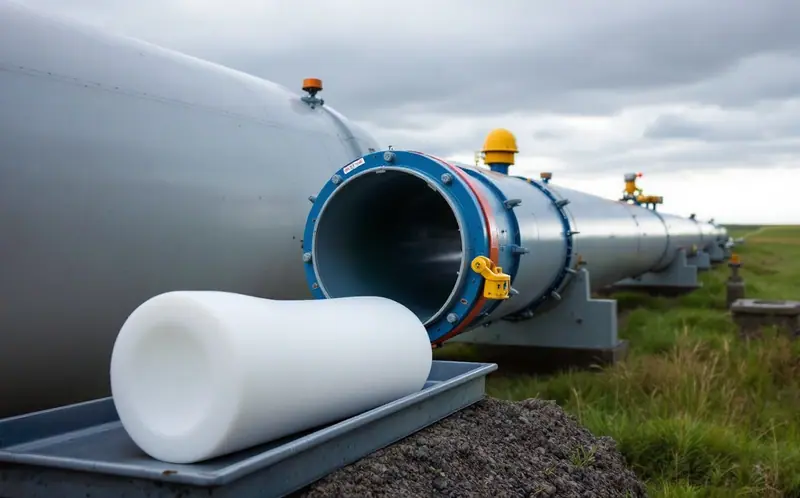
Stand at a valve site on most liquids pipelines and you will see a fat section of pipe off the main line, with a heavy closure on the end and small valves around it. That is a pig trap. Somewhere upstream there is a matching one, and between the two, every so often, a pig travels the length of the line pushed by the product itself.
A pig is any device that rides through the inside of a pipeline to do a job: scrape it, separate one batch of product from the next, push out water, prove the bore is open, or record the condition of the steel. This piece walks through the main families, the hardware at each end, a run from start to finish, and why some lines can take a pig and others cannot.
Why a pipe needs anything sent through it
A pipeline looks like a sealed tube that just moves product, but the inside changes over time. Crude lines collect wax as the oil cools. Gas lines pick up liquids that drop out and pool in low spots, along with dust and corrosion products. Water left over from a pressure test or from wet gas can sit in sags for years. A multiproduct line that carries gasoline one week and diesel the next needs some way to keep the two from mixing more than necessary.
All of that cuts throughput, and water in particular feeds corrosion on the inside wall. Pigs are the oldest answer. The second reason, and the one that gets most of the attention now, is inspection: an instrumented pig can measure the pipe wall from the inside over tens or hundreds of kilometers without digging anything up.
Utility pigs: the working tools
Utility pigs do the housekeeping. They come in a handful of basic shapes, and operators pick one for the job and the line.
| Pig type | What it looks like | Typical job |
|---|---|---|
| Foam pig | A bullet of open-cell polyurethane foam, sometimes with a harder coated skin | Drying, light cleaning, proving a new line, swabbing out liquid |
| Steel-bodied cup or disc pig | A steel body carrying replaceable urethane cups or discs, often with wire brushes or magnets | Cleaning, scraping wax, pushing out debris and water |
| Molded urethane pig | A one-piece urethane body with built-in cups or discs | General cleaning and batching where a steel body is not needed |
| Sphere | An inflatable or solid ball, sized to the bore | Batching and separating products, removing liquid from gas lines |
| Gauging (sizing) pig | A steel-bodied pig carrying one or more notched metal plates | Proving that the bore has no dents or restrictions |
Cleaning pigs use cups, discs and wire brushes to scrape the wall, and some carry magnets to pick up loose metal. Batching pigs and spheres sit between two products in a line that carries more than one, so the interface between them stays short. Dewatering and drying runs usually follow a pressure test on a new line, when a train of foam or cup pigs pushes the test water out and a dry pig or two follows.
The gauging pig is the plainest and one of the most useful. Its plate is slightly smaller than the bore and made to bend. If the pig comes out with the plate untouched, the line has no restriction that would hang up a bigger tool. If the plate comes out bent, someone has a reason to find out where and why before sending anything expensive.
Smart pigs: in-line inspection tools
PHMSA's fact sheet on in-line inspection tools describes them as devices that travel through the pipe and record irregularities that may be corrosion, cracks, laminations, dents, gouges or other defects. They got the nickname "smart pigs" because they move through the line the same way the cleaning pigs do. Instrumented tools of this kind go back to the 1960s, and the early ones used magnetic flux leakage, which is still a workhorse.
The main families:
- Magnetic flux leakage (MFL). Strong magnets saturate the pipe wall, and where metal has been lost to corrosion or a gouge, some of the magnetic flux leaks out of the wall. Sensors between the magnet poles measure that leakage and the tool stores the data for analysis afterward. MFL is the standard way to find and size metal loss.
- Transverse flux. The same idea with the magnetic field turned 90 degrees so it wraps around the pipe. That orientation makes it better at long, narrow corrosion along the pipe, such as corrosion along a seam weld. It can pick up some axial cracks too, but PHMSA notes it is less reliable for cracks than for corrosion.
- Compression wave ultrasonic. Transducers fire ultrasonic pulses straight into the wall and time the echoes from the inside and outside surfaces, which gives a direct wall thickness reading. The pipe has to be clean for this to work, so a cleaning run usually comes first, especially in crude lines with paraffin.
- Shear wave ultrasonic. Here the pulses go around the circumference at an angle, which is the direction in which crack-like defects show up best. PHMSA calls it the most reliable method for longitudinal cracks, seam weld flaws and stress corrosion cracking. It needs a liquid in the line, oil or water, to carry the sound into the steel.
- Geometry or caliper tools. Mechanical arms or electronic sensors measure the bore itself, finding dents, ovality and other changes in shape. Operators often run one alongside or ahead of an MFL or ultrasonic tool.
No one tool sees everything, which is why the choice depends on the pipe material and wall thickness, the defects the operator expects to find and how much risk sits on that stretch of line.
Launchers and receivers
The pig trap at each end is a short length of pipe larger than the line, called the barrel, with a quick-opening closure on the end and a reducer that steps it down to the line size. A launcher sits at the upstream end and a receiver at the downstream end. Around each one you will find isolation valves, a "kicker" line that lets product flow in behind the pig, vent and drain connections, and a pressure gauge.
The basic idea is simple. The barrel is isolated from the line, depressured and drained so the closure can be opened safely. The pig goes in, the closure is shut, the barrel is filled and brought back up to line pressure, and then the valves are set so product flows in behind the pig and pushes it out into the main line. At the receiver the sequence runs the other way. These steps carry real hazards: trapped pressure behind a closure, flammable or toxic product in the barrel, and in sour service, hydrogen sulfide. That is why traps carry interlocks that stop the closure from opening while there is pressure inside, and why the work is done by trained and qualified people following the operator's written procedure, never from memory.
A run from launch to receive, step by step
Here is how a routine cleaning run might go on an illustrative line: a 12-inch crude line about 60 km (37 mi) long between a pump station and a terminal, with wax building up over the winter. The numbers are round and made up for the example. The steps are the ones you would see on a real job.
- Planning. The control room and field crew agree a day and time, the flow rate the line will run at, and who is at each end. The control room needs to know because a pig in the line changes pressures and flows, and a stuck pig shows up first on its screens.
- Prove the line. If the line has not been pigged in a while, the first pig is often a soft foam pig or a gauging pig, so that if something is wrong inside, the cheap tool finds it rather than the expensive one.
- Load the launcher. Following the procedure, the crew isolates, depressures and drains the barrel, opens the closure, pushes the pig in until its cups seal in the reducer, and closes up. The barrel is brought back to line pressure.
- Launch. The valves are set so flow goes through the barrel behind the pig. The pig leaves the barrel, and a passage indicator just downstream of the trap trips to confirm it has gone. The launch time is logged.
- Track it. At an average of, say, 1 m (about 3 ft) per second, the pig would take around 17 hours to cover 60 km, so the crew estimates when it will pass each block valve along the way. Someone may wait at a valve site with a hand-held receiver or check a fixed passage indicator to confirm the pig went by on time.
- Watch for trouble. If pressure upstream of the pig climbs and the pig stops arriving at checkpoints, it may be stuck on debris, a wax plug or a fitting. Many systems are built so a pig can be pushed back the way it came if needed.
- Receive. The receiver valves are set to bring flow through the barrel. The pig arrives, the passage indicator trips, flow is returned to normal, and the barrel is isolated, depressured and drained before anyone opens the closure.
- Read the pig. A cleaning pig tells its own story. Worn cups, a load of wax packed in front of it, or a bent gauge plate all go in the report, and they decide whether the next run uses a more aggressive tool or whether the line is clean enough for an inspection tool.
An inspection run follows the same steps with more care, because the tool is heavier and its data is the reason for the trip.
Knowing where the pig is
Steel pipe blocks radio and GPS, so a pig cannot simply report its position as it goes. Inspection tools keep their own record using odometer wheels that roll along the wall, along with inertial sensors that track direction and tilt. On the surface, crews place markers at known locations that detect the pig going by from its magnetism, its sound or a low-frequency transmitter it carries. Afterward, the analysts line up the tool's own record with those surface fixes, so a defect found at a certain distance down the line can be pinned to a spot someone can dig up.
A metal loss feature somewhere along a 60 km line is no use to a dig crew. One tied to a distance from the nearest above-ground marker is.
Piggable and unpiggable lines
A line has to be built for pigging. Pig traps have to exist at both ends, the bore has to stay roughly the same size the whole way, bends have to be gentle enough for the tool to get round, and valves have to open to the full bore. Reduced-port valves, butterfly valves, sharp bends, changes in diameter and instruments that poke into the bore can all stop a pig or damage it.
Size is a limit too. PHMSA notes that about six inches is usually the smallest diameter for many in-line tools, and pipe smaller than that may have to be checked by pressure testing instead. Older lines built before pigging was routine often fall into the unpiggable group. Operators can sometimes convert them by replacing valves, adding traps or cutting out tight bends, or they use other methods: pressure tests, direct assessment by digging and examining selected spots, and for cleaning, alternatives such as ice pigging, where a slurry of ice is pumped through the line in place of a solid pig.
Where the name comes from
Nobody knows for certain. The story you hear most often is that early cleaning devices, made from straw bales wrapped in barbed wire or from leather, squealed as they were pushed through the pipe, and someone thought they sounded like pigs. You will also see "pipeline inspection gauge" offered as the meaning of the letters, but that looks like a phrase fitted to the word later. Either way, the name stuck, and the barrels at each end are called pig traps.
What to look at next time you pass a trap
Next to a launcher or receiver, look for the interlock on the closure, the vent and drain lines and the passage indicator just downstream. If you want more on how lines like this fit into the rest of the gas system, the natural gas value chain explainer covers where gathering and transmission lines sit, and the pipelines and midstream hall collects the rest of our pipeline pieces. Pipeline construction starts long before the first pig run, with welders joining the pipe, and the welding demonstrations guide explains what you are watching at a show.
The practical point to take away is that pigging is routine maintenance, not an emergency measure. A line that gets pigged on a regular schedule tells its operator much more about its own condition than one that only gets attention when the flow drops.

Esteban Villarreal
Esteban is from Corpus Christi, Texas, and writes about pipelines, terminals and refining along the Gulf Coast and beyond. He likes a good process diagram and a clear answer to where the barrel goes next.