Home / Guide
Guide
Pipeline welding demonstrations: what you are watching
A plain guide to watching a pipeline welding demo at an industry show: the processes, the root, hot, fill and cap passes, inspection, the standards and what to ask.
 By Lorne HalvorsenFirst posted at this address on 7 min read
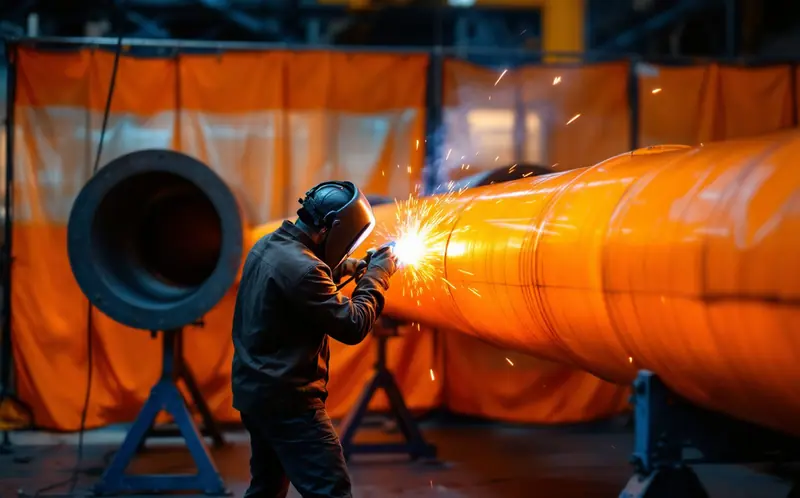
At most big oil and gas shows there is a corner of the hall that draws a crowd for reasons nobody has to explain: the sound of an arc, a shower of sparks behind an orange curtain, and a welder in leathers working around a length of pipe on stands. Welding demos are some of the most watched spots on any floor, and some of the least understood.
This guide explains what is going on in a pipeline welding demonstration: the processes you are likely to see, the order of the passes, how the joint is prepared, how welds are checked, the rules that sit behind it, and some good questions to ask the person holding the stinger. For the wider layout of a show floor, see our guide to reading an exhibition floor.
Why pipeline welding is its own trade
A pipeline is a long chain of pipe joints, each one joined to the next by a girth weld that runs all the way around the pipe. On a cross-country line there are thousands of them, made outdoors, in wind, rain and cold, often with the pipe fixed in place so the welder has to work around it instead of turning it. Each weld has to hold pressure for decades. That combination, field conditions and no room for a bad weld, is why pipeline welding has its own procedures, its own tests and its own standards.
The processes you are likely to see
| Process | Common name | Where you see it on pipelines | What to look for at a demo |
|---|---|---|---|
| Shielded metal arc welding (SMAW) | Stick | Manual girth welds, tie-ins, repairs, smaller crews | A coated rod burning down in the holder, slag left on the bead |
| Gas metal arc welding (GMAW) | MIG, wire | Mechanized and automatic welding on large-diameter lines | A welding head on a band clamped around the pipe, wire feeding from a spool |
| Flux-cored arc welding (FCAW) | Flux-core | Fill and cap passes, some semi-automatic work | A wire gun like MIG, but with slag on the finished bead |
| Plasma arc cutting | Plasma | Cutting and bevelling, not welding | A narrow, very bright arc slicing cleanly through plate or pipe |
Stick welding with cellulosic rods
The classic picture of pipeline welding is a welder running stick downhill with cellulosic electrodes. These rods have a coating that produces a forceful, deep-penetrating arc, which is useful for the root of a pipe joint. Welding pipe this way means starting at the top and moving down each side, called vertical down or downhill, which allows high currents and fast travel. That speed is why so many cross-country lines have been welded downhill with cellulosic rods.
The trade-off is hydrogen. Cellulosic coatings carry moisture, which adds hydrogen to the weld and raises the risk of cracking in higher-strength steels. That is one reason procedures often call for preheat, and why low-hydrogen rods or other processes are used on some grades.
Mechanized and automatic welding
On big-inch lines with long runs of the same pipe, many contractors use mechanized GMAW. An internal line-up clamp holds the two pipe ends together from the inside, and on some systems carries welding heads that put in the root pass from the inside. External welding bugs ride on a steel band around the pipe and lay down the remaining passes. The finished cap is narrow and uniform in a way that is hard to match by hand.
The passes: root, hot, fill and cap
A pipeline girth weld is built up in layers, and good demonstrators will name each one as they go.
- The root pass is the first bead, laid in the gap at the bottom of the joint. It has to fuse both pipe ends all the way through the wall. It is the hardest pass to get right and the one inspectors watch most closely.
- The hot pass follows, often soon after the root, to burn out any slag lines and give the root some strength before the clamp comes off or the pipe is moved.
- Fill passes build the groove up toward the outside surface. On thick-wall pipe there can be several.
- The cap pass is the final layer, slightly wider than the groove and slightly above the surface, which is what most visitors photograph.
Between passes the welder cleans each bead, usually with a power wire brush or grinder, so slag is not trapped under the next one.
Before the arc: bevel, fit-up, clamps and preheat
Much of the quality of a weld is set before anyone strikes an arc.
The pipe ends are bevelled, cut at an angle so there is a groove for the weld metal, usually with a small flat land at the inside edge. Mechanized systems often use special bevel shapes that need a facing machine to cut them precisely. The two ends are then brought together with a line-up clamp, internal or external, which holds them round, lined up and at the right gap. That alignment is called fit-up, and a poor fit-up makes a good root almost impossible.
Preheat comes next on many procedures: warming the joint with a torch or an induction coil to a set temperature before welding. Preheat slows cooling and helps hydrogen escape, which lowers the risk of cracking.
Checking the weld
A weld that looks good can still hide defects, so pipeline welds are checked by nondestructive testing. The two methods you are most likely to see explained at a booth are:
- radiography, which takes an X-ray or gamma-ray image of the weld on film or a digital detector, showing porosity, slag and lack of fusion as shapes on the image
- automated ultrasonic testing (AUT), where a scanner rides around the weld on a band and sends sound pulses into the steel, recording reflections from flaws. It is widely used on mechanized girth welds and produces results quickly, without the radiation exclusion zone that radiography needs.
In the United States, federal gas pipeline rules set minimums for how many field welds must be tested this way: at least 10 per cent of each day's field butt welds in Class 1 locations, at least 15 per cent in Class 2, and 100 per cent of tie-in welds, with the strictest rules applied at crossings and in more populated areas.
The standards behind it
Two names come up again and again around pipeline welding.
In the US, API Standard 1104, Welding of Pipelines and Related Facilities, covers the welding of carbon and low-alloy steel pipe used for crude oil, products and fuel gases. Federal gas pipeline rules require welders and welding procedures to be qualified under API 1104 or under Section IX of the ASME Boiler and Pressure Vessel Code; the text is in 49 CFR 192.227 and the sections around it.
In Canada, the governing standard is CSA Z662, Oil and Gas Pipeline Systems, which covers design, construction, operation and maintenance, including welding. Federal pipeline rules incorporate it by reference, as you can see in the Canadian Energy Regulator Onshore Pipeline Regulations, and provincial regulators apply it to pipelines under their oversight.
How welders qualify
A pipeline welder does not just show up with a hood and a truck. The welding procedure itself is qualified first: test welds are made to a written procedure and then tested destructively, cut into strips and bent, pulled or broken to show the metal inside is sound. Each welder then takes a qualification test on that procedure, welding a test joint in the positions the job needs, and that weld is cut and tested too. Pass, and the welder is qualified for a range of pipe sizes, wall thicknesses and positions covered by the test. If you see coupons cut from a test weld on a booth table, that is what they are for.
Safety around a demo
A welding arc gives off ultraviolet and infrared light strong enough to burn the eyes and skin, and welding fumes contain metal particles and gases you do not want to breathe. Good demo areas keep visitors behind tinted welding curtains, at a distance, with extraction pulling fumes away from the crowd. Look through the curtain, not around it, and never stare at an open arc without proper filter lenses. If a demonstrator hands out viewing glasses, use them. Plasma cutting is just as bright and very loud, so expect hearing protection to be offered there too.
What to ask a demonstrator
Demonstrators are usually welders or product people who like talking about the work. A few questions get good answers:
- Which process and filler is this, and what kind of pipe grade is it meant for?
- Is that procedure qualified to API 1104 or CSA Z662, and what positions does it cover?
- How do you control preheat and interpass temperature in the field?
- What defect do you see most often in the root, and what causes it?
- How is this weld usually inspected, radiography or AUT?
- What is the hardest part of training a new hand on this equipment?
For the other kinds of activity you will find at a show, from technical sessions to receptions, see our guide to industry events, and the pipelines and midstream hall covers what happens to the line after the last weld is capped. When you watch the next demo, keep your eye on the root pass: everything that comes after it depends on that first bead.