Hall D · Pipelines & Midstream
A pipeline construction spread, from right-of-way to hydrotest
How a cross-country pipeline gets built, crew by crew: survey, clearing, grading, stringing, bending, welding, inspection, coating, lowering-in and testing.
 By Esteban Villarreal9 min read
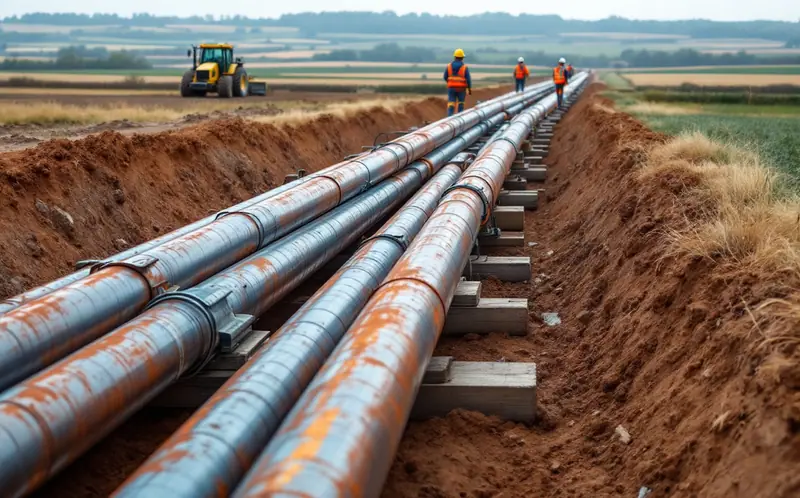
Drive a rural highway in the right season and you may pass one: a strip of bare ground 30 m (100 ft) or so wide running straight over the hills, a line of pipe lying on wooden skids beside it, and a string of yellow machines spaced out over several kilometers. That strip is a pipeline construction spread, and the machines are not working at random. Each group is a crew with one job, and the crews move down the right-of-way in a fixed order, like stations on an assembly line that walks.
This piece follows a spread from the first survey stake to the day the land is handed back. Details change with terrain and local rules, but the order of work is close to universal.
What a spread is
A spread is a section of pipeline, often tens of kilometers or more, built by one contractor organization with its own crews, equipment and management. Long projects are split into several spreads that work at the same time. Inside a spread the work is divided by task, and each crew follows the one ahead of it. If the welding crew stops, everyone behind it soon runs out of work, so a spread superintendent spends much of the day watching gaps.
The crews, front to back
| Crew | What it does | What you see |
|---|---|---|
| Survey | Stakes the centerline, workspace edges and buried utilities | Lath and flagging, small crews in pickups |
| Clearing | Removes trees and brush, sets up erosion and sediment controls | Mulchers, feller bunchers, silt fence |
| Grading and topsoil | Strips and stores topsoil, levels a work surface | Dozers, long berms of dark soil at the edge |
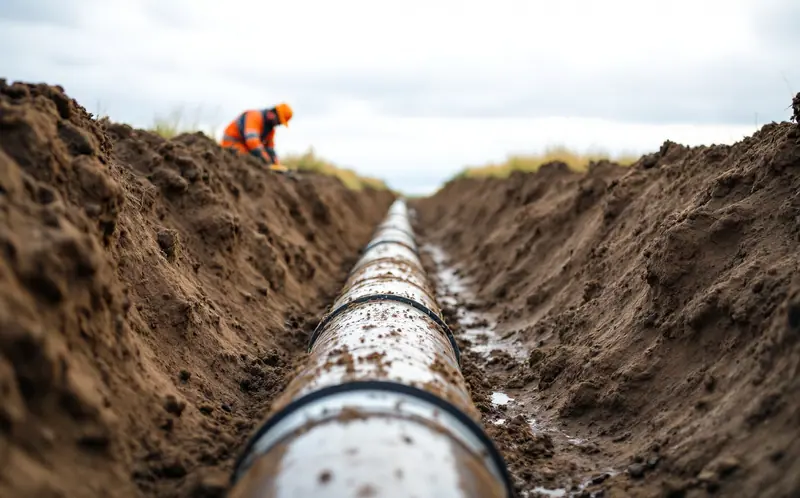
| Ditching | Digs the trench | Excavators or wheel trenchers, spoil piles |
| Stringing | Lays pipe joints end to end along the ditch | Pipe trucks, joints on skids |
| Bending | Shapes joints to fit the ground | A bending machine, one joint at a time |
| Welding and NDT | Joins the joints, then examines the welds | Welding shacks or tents, X-ray and ultrasonic crews |
| Coating | Coats the bare steel at each weld | Sandblasting, heating, sleeves or liquid coating |
| Lowering-in | Puts the welded string in the ditch | Sideboom tractors working in a row |
| Backfill and cleanup | Fills the ditch, replaces topsoil, reclaims | Dozers, seed drills, fencing crews |
| Testing | Pressure tests the finished line | Fill pumps, test heads, chart recorders |
Survey and right-of-way
Before any machine moves, the route has been through land agreements and regulatory approval. On the ground, the survey crew stakes the centerline and the edges of the right-of-way and any extra temporary workspace at road crossings, rivers and steep slopes. They also locate every buried line and cable the route crosses.
The right-of-way is usually split into a spoil side, where the ditch dirt will go, and a work side, wide enough for trucks and sidebooms to pass each other. That layout decides where everything else sits.
Clearing, grading and topsoil
Clearing crews cut and mulch or haul away trees and brush. Erosion controls such as silt fence along watercourses go in early.
Grading follows. On farmland in Western Canada and much of the US, the topsoil is stripped first and piled separately at the edge of the right-of-way so it can go back on top at the end, not buried under subsoil from the ditch. Watch for two long berms on a farm spread, one dark and one lighter; that is topsoil and subsoil kept apart. Grading then levels a safe working surface, which on side slopes can mean cutting a bench into the hill.
Ditching
The ditch is dug by excavators or, in suitable soil, by a wheel trencher that cuts a continuous trench as it crawls along. Depth is set by the cover the line needs over the top of the pipe. In the US, 49 CFR 195.248 requires at least 30 inches (762 mm) of cover in normal soil for most hazardous liquid lines in rural areas, rising to 36 inches (914 mm) in developed industrial, commercial and residential areas, and 48 inches (1,219 mm) at inland water crossings at least 100 ft wide. Gas transmission lines under 49 CFR 192.327 need 30 inches in normal soil in Class 1 locations and 36 inches in Class 2, 3 and 4. These are minimums, and a project can choose to bury deeper where farming, drainage or erosion call for it.
Where the ditch hits bedrock, crews may rip or blast it, and the rules allow less cover in rock.
Stringing and bending
Pipe arrives from the mill or a coating yard already coated except for a short bare band at each end. Trucks carry the joints out along the work side, and a sideboom or loader sets them end to end on wooden skids beside the ditch. That is stringing.
The ground is never as straight as a pipe joint, so the bending crew shapes joints to follow dips, rises and turns in the route. A bending machine grips each joint and pulls it in small steps to the angle the field engineer measured. The rules for steel lines require each field bend to keep a smooth contour, free from buckling, cracks or other damage, and on pipe with a longitudinal seam the seam is kept as near as practicable to the neutral axis of the bend, so it is not stretched or squeezed. Sharper changes of direction use factory bends made in a shop.
Welding and weld inspection
Line-up clamps hold two joints together at the right gap, and welders put in the root, hot, fill and cap passes, either by hand with stick electrodes or with mechanized systems riding on a band around the pipe. Our guide to pipeline welding demonstrations explains the passes and processes in detail. What matters for the spread is pace, because every crew behind the welders depends on it.
Behind the welders come the nondestructive testing crews, with radiography or automated ultrasonic equipment. How many welds they must examine depends on where you are:
- In Canada, the CER's Onshore Pipeline Regulations, section 17, say that when a company joins pipe it must examine the entire circumference of each joint by radiographic or ultrasonic methods.
- For US gas lines, 49 CFR 192.243 sets random testing each day of at least 10 percent of field butt welds in Class 1 locations and 15 percent in Class 2, rising to 100 percent (or not less than 90 percent where testing is impracticable) in Class 3 and 4 locations, at major river crossings, offshore and in road and railroad rights-of-way. Tie-ins are tested 100 percent.
- For US liquid lines, 49 CFR 195.234 requires at least one-tenth of the girth welds made by each welder on each welding day, and all girth welds in sensitive places such as water crossings, road and railroad rights-of-way and populated areas.
A weld that fails inspection is repaired or cut out. For US gas lines, the operator must keep a record of the girth welds made, the number tested and rejected, and how the rejects were handled, for the life of the pipeline.
Coating the joints
The bare band at each weld has to be coated before the pipe goes in the ground. The field coating crew cleans the steel, often by sandblasting, heats it, and applies a coating system such as a heat-shrink sleeve or a liquid epoxy. Then someone walks the line with a holiday detector, a wand or ring that passes a high voltage over the coating and sparks or beeps at any pinhole or thin spot, called a holiday. The US rules require each external coating to be inspected just before the pipe is lowered into the ditch and any damage to be repaired. Coating is the first line of defense against corrosion, and our explainer on pipeline integrity covers what it does over the following decades.
Lowering-in and backfill
Several sideboom tractors line up along the work side, each holding the welded string in a padded sling, and they lift and walk it over the ditch together, then lower it in a smooth curve.
The bottom of the ditch is prepared first, and in rocky ground crews lay sifted soil or sand padding under and around the pipe so sharp stones do not damage the coating. US rules say backfill must give firm support under the pipe and prevent damage to the pipe and coating from equipment or backfill material. On steep slopes, trench breakers of sandbags or foam go in before backfill so water does not run down the ditch line and wash it out.
Crossings are usually built by separate crews: roads and railways are often bored, and rivers may be crossed by horizontal directional drilling, which pulls a pre-welded section through a curved hole under the riverbed. A tie-in crew then joins each crossing to the mainline.
Testing
Before product goes in, the line is pressure tested, usually with water in what the trade calls a hydrotest. A section is filled, often by pushing pigs ahead of the water to remove air (the pigging explainer covers those tools), then pressured well above its planned operating pressure and held. For US liquid lines, 49 CFR 195.304 requires at least 4 continuous hours at 125 percent or more of the maximum operating pressure, plus 4 more hours at 110 percent or more if the line is not visually inspected for leakage during the test. In Canada, the CER regulations require a pressure test program before a line goes into service. Afterward the water is pushed out, treated as needed and disposed of under permit, and the line is dried.
A worked example: walking an illustrative spread
To show how the crews spread out, take a made-up spread of 80 km (50 mi) of 24-inch pipe over open farmland. Every number here is round and illustrative, not taken from a real project.
- Suppose the welding front averages 1.5 km a day. At that pace the mainline welding takes about 53 working days, before weather and crossings.
- Clearing and grading stay well ahead, say 10 to 15 km, so a wet week does not stop the welders.
- Ditching runs a few kilometers ahead of or behind the welders. A ditch left open for long caves in, fills with water and is a hazard to people and livestock.
- Coating and lowering-in trail the welders by a few kilometers, because welds must be inspected and passed before they are coated.
- Backfill follows lowering-in closely, often within a day or two.
- Cleanup and reclamation run last, and may lag by weeks if the soil is too wet to work without damaging it.
So on any one day, an observer driving from the front to the back of this spread might cover 30 km or more and see every stage at once.
Cleanup and reclamation
The last crews put the land back. Subsoil goes into the ditch, the ground is recontoured, topsoil is spread back on top, and the right-of-way is reseeded, often with a seed mix agreed with the landowner or regulator. The CER regulations say the right-of-way and temporary work areas must be restored to a condition similar to the surrounding environment and consistent with current land use. On a US gas transmission line with 1,000 ft or more of continuous backfill, 49 CFR 192.319 adds a coating survey using DCVG, ACVG or comparable technology no later than six months after the line goes into service, to catch coating damaged during backfill.
When you next see that bare strip over the hills, look for the topsoil berm at the edge. If it is still there, the line is not finished, however much pipe is already in the ground.

Esteban Villarreal
Esteban is from Corpus Christi, Texas, and writes about pipelines, terminals and refining along the Gulf Coast and beyond. He likes a good process diagram and a clear answer to where the barrel goes next.