Hall B · Heavy Oil & Oil Sands
Oil sands mining versus in situ recovery: two ways to get bitumen
Why a small slice of Alberta's oil sands is dug up with shovels and trucks while most is produced through wells, and how the two methods differ on land and water.
 By Lorne Halvorsen9 min read
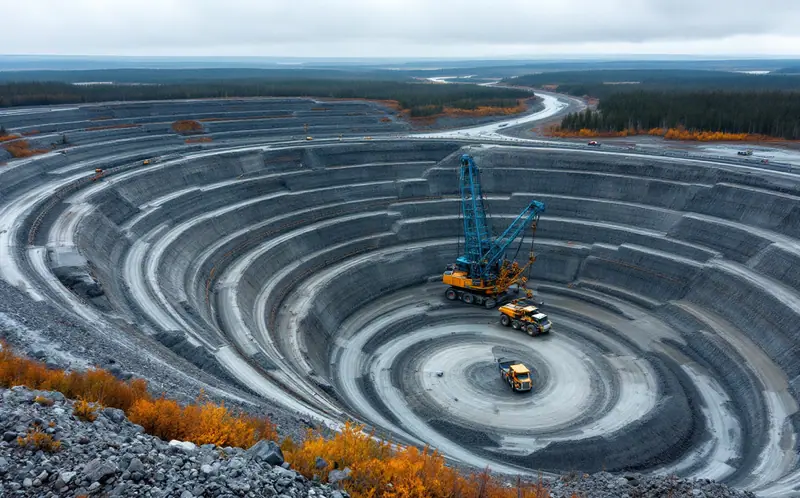
There are two ways to get bitumen out of the Alberta oil sands, and they could hardly look more different. One is a mine: an open pit the size of a small town, electric shovels the height of a house, and haul trucks with tires taller than the man changing them. The other is a gravel pad in the bush with a row of wellheads and some insulated pipe, which you could drive past without noticing. Both produce the same raw material. Which one a company uses is decided almost entirely by one number: how far down the oil sand sits.
This piece walks through each method in turn, starting with a tour of a mine, then compares them side by side on depth, land, water and what is left behind. Partway through there is a worked example with round, illustrative numbers to give a sense of the tonnages a mine moves.
Depth decides
The oil sands are a mix of sand, clay and other minerals, water and bitumen, the extra-heavy oil that is too thick to flow at reservoir temperature. According to the Government of Alberta, they lie beneath about 142,200 square kilometres (some 54,900 square miles) of the province, in three areas: Athabasca, Cold Lake and Peace River.
Only a thin slice of that is close enough to the surface to dig. The province puts the limit for mining at about 75 m (roughly 250 ft) of depth, and deposits that shallow occur only in the Athabasca area, around Fort McMurray. The surface mineable area is about 4,800 square kilometres, roughly 3.4 percent of the total oil sands area. The Alberta Energy Regulator (AER) says surface mining can reach about 20 percent of the resource. The other 80 percent is too deep and has to be produced through wells, with most in situ production coming from about 350 to 600 m below surface.
So the question is not which method is better. Below 75 m or so, digging stops making sense because the pile of rock and soil you would have to move to reach the ore grows faster than the ore itself. Above it, a mine can recover bitumen from oil sand that wells would struggle to drain.
A tour of a mine
If you ever get onto a viewpoint above one of the Athabasca mines, here is what you are looking at, roughly in the order the ground goes through it.
Clearing and draining
Before any digging, the forest is cleared and the muskeg, the wet peat that covers much of the north, is drained. Muskeg on top of the oil sands is typically 1 to 3 m (3 to 10 ft) thick. Under it is the overburden: clay, gravel and barren sand that carry no bitumen worth recovering. The good topsoil and peat are salvaged and stockpiled for reclamation later, because they are the hardest material to replace.
The pit
Once the overburden is stripped, the ore body is exposed. The oil sand is typically 40 to 60 m (130 to 200 ft) thick, lying on limestone. It is dug in benches, the stepped terraces you see on the pit walls. The Government of Alberta describes the equipment as shovels with a bucket capacity of about 45 cubic metres and trucks that carry up to about 400 tonnes a load. The trucks haul ore to a crusher at the edge of the pit, and that is where the haul road ends.
Crushing and the slurry line
The crushed ore is mixed with hot water to make a slurry, which is pumped through a pipeline to the extraction plant. Moving ore as slurry saves a great many truck trips, and the trip down the pipe also starts to loosen the bitumen from the sand.
Extraction: hot water and froth
The hot water method goes back to Karl Clark, a chemist with the Scientific and Industrial Research Council of Alberta, who worked out in the 1920s how hot water and reagents could separate bitumen from the sand. The plants of today run variations of the same idea.
In a large tank called a primary separation vessel, the sand sinks and the bitumen, attached to fine air bubbles, floats to the top as a froth. That froth is still far from clean oil: it carries a lot of water and some fine solids. The AER notes an interesting detail here. The plants use nonsaline water partly because it dilutes the salt naturally present in the oil sands, which helps the bitumen separate.
Froth treatment
The froth is diluted with a light hydrocarbon solvent, either naphthenic (a naphtha) or paraffinic, so that the remaining water and minerals can be separated from it. The solvent is recovered and reused, and the cleaned bitumen goes on either to an upgrader or to be blended for the pipeline.
Tailings
Everything that is not bitumen, meaning sand, silt, clay, water and a little residual oil, leaves the plant as tailings and is pumped to tailings ponds, where the sand settles out. Water is drawn off the ponds and recycled back to the plant. Tailings are the largest environmental job on a mine and a subject of their own, so here it is enough to say that only mining makes them.
Worked example: what a mine moves
The Government of Alberta gives a rule of thumb that it takes about 2 tonnes of oil sand, along with 2 to 4 barrels of water, to produce one barrel of synthetic crude oil. The numbers below build on that. They are round and illustrative only, not the figures of any real mine.
- Suppose a mine aims to produce 100,000 barrels of synthetic crude a day.
- At about 2 tonnes of oil sand a barrel, it must dig and process around 200,000 tonnes of ore every day.
- If each haul truck carries 400 tonnes, that is 500 truckloads of ore a day, or about 21 an hour around the clock.
- None of that counts the overburden. Where the ore is deeper, a mine may have to move as much waste material again, or more, before it reaches each tonne of oil sand.
That arithmetic is why mines run around the clock, why the trucks are as large as they are, and why the cut-off depth matters so much. Double the overburden and you double a large part of the earthmoving without adding a single barrel.
In situ: leaving the sand where it is
In situ means "in place". Instead of bringing the sand to the plant, the operator heats or thins the bitumen underground so that it flows to a well. The Government of Alberta lists the main commercial methods as cyclic steam stimulation (CSS), where one well both injects steam and produces oil, and steam-assisted gravity drainage (SAGD), where two parallel horizontal wells do the two jobs. It also describes cold heavy oil production with sand, used in the Cold Lake area, and other methods that have only been tested.
The SAGD well pair, the steam chamber and the plant that treats the produced water are covered in detail in our piece on SAGD and how steam brings bitumen up, so I will not repeat them here. The key point for this comparison is what in situ does not need: no pit, no crushers, no slurry lines, and, as the province puts it, no tailings ponds, because the sand stays in the ground.
The two methods side by side
| Surface mining | In situ (mostly SAGD and CSS) | |
|---|---|---|
| Depth of deposit | Down to about 75 m, Athabasca area only | Deeper; most production from about 350 to 600 m |
| Share of the resource | About 20 percent | About 80 percent |
| How bitumen is freed | Ore dug, crushed and washed with hot water at a plant | Steam or solvent makes bitumen flow to wells underground |
| What reaches the plant | Ore, as a water slurry | Hot bitumen and water from the producing wells |
| Main surface footprint | Open pits, overburden dumps, plants and tailings ponds | Well pads, roads, pipelines and a central plant |
| Tailings ponds | Yes | No |
| Nonsaline water per barrel | Higher, drawn mainly from the Athabasca River | Much lower; produced water is treated and recycled |
| Reclamation at the end | Pits backfilled, landforms rebuilt and replanted | Wells plugged, pads and roads removed and replanted |
Land
The difference in land use is the one most people notice. A mine disturbs everything within its working area, down to the base of the ore. The Government of Alberta reported that the disturbed surface mineable area was about 895 square kilometres in 2013, less than 1 percent of the total oil sands area and about 0.2 percent of Alberta's boreal forest.
In situ projects disturb much less ground per barrel, but they spread it out. Pads, access roads, pipelines and the old seismic lines used to map the reservoir cut the forest into long strips and patches that take years to grow back. Reclamation is simpler: the province describes it as removing pads and roads, replacing suitable soil, filling the well bores, capping them with concrete plugs and burying them.
On a mine, reclamation is a rebuilding job. Processed sand and tailings sediment go back into the mined-out pit, overburden is placed on top, salvaged soil goes over that, and the area is replanted with native species. The AER regulates how that land is returned to its original state or an equivalent one, and companies need its approval before they mine at all.
Water
Water is where the two methods differ most in the numbers. In the AER's annual water use performance reporting, oil sands mining uses far more nonsaline water per barrel than in situ, and mining accounts for most of the nonsaline water used by Alberta's energy industry. The Athabasca River is the main source of make-up water for the mines, with groundwater and runoff collected on the mine sites making up the rest.
Most of the water a mine uses on a given day is recycled from its tailings and storage ponds, not fresh. The AER states that process-affected water is not released from oil sands mine sites. In situ plants, for their part, recover most of their water with the bitumen and treat it for reuse in the steam generators, and some draw make-up water from saline aquifers that are no use for drinking or farming.
Which is "better"?
Neither, really. They answer different geology. A mine can only work where the ore is shallow, and where it is shallow a mine recovers bitumen that wells would leave behind. In situ is the only practical way to reach the deep 80 percent. The trade-offs show up in different places: mines in tailings, water draw from the river and large disturbed areas that take decades to rebuild; in situ in the natural gas burned to raise steam and in forest cut up by pads and lines.
If you want the regulator's own description of each method, the AER's oil sands mining page sets out what it requires of a mine, and the Government of Alberta's Oil sands 101 page covers both methods in brief. Our heavy oil and oil sands hall gathers the rest of our reading on bitumen, and the history of how the first mine came to Fort McMurray is told in our piece on Calgary and the oil patch.
One practical tip if you ever visit the region: when someone tells you a project is "oil sands", ask whether it is a mine or a thermal project before you ask anything else. Almost every other answer about the site, from the jobs on it to the water it uses, follows from that one.

Lorne Halvorsen
Lorne lives outside Red Deer, Alberta, and has spent most of his working life around rigs and service crews in the Western Canadian basin. He writes about drilling, completions and heavy oil in the plain terms he wishes someone had used with him.